• Video & Arcade Top 10 was weird

    In 1997, Canadian TV show, Video & Arcade Top 10 listed off the following as the “Pioneer Top Five” for the best-selling LaserDisc titles:

    • Godfather I Wide Screen
    • Godfather II Wide Screen
    • Godfather III Wide Screen
    • Terminator II Collector’s Edition
    • Evening Star Wide Screen

    Considering DVD came out the year that Pioneer had created this list for a video game show targeted at youths, it’s pretty freaking wild.

    Also, the Godfather movies were all released a decade before the average target audience were even born and would combined take about nine hours to watch.
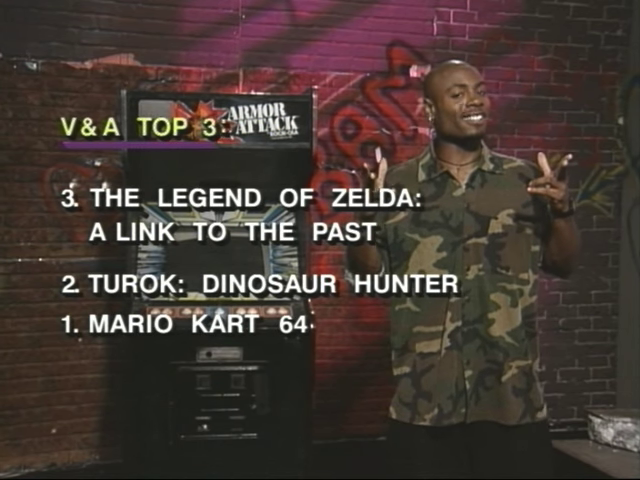
    This show is just really weird. Aside from the LaserDisc top-five which never seemed to change in a single season, the music prizes were odd and the “Top 10” of the show’s own title didn’t seem to matter much either.

    Second place contestants were given both a bath time “Game Boy” toy and two compact discs: Slow Jams Volume 2 and Dance Mix USA 97 Canadian Limited Edition.

    With Slow Jams Volume 2, the track listings included songs like Tonight I Celebrate My Love, Between the Sheets, and As We Lay which are all titles a tween would want to have in their music collection. I don’t have much to comment on the other album.

    Aside from the interesting undertones presented in one of the two CDs, there’s also this egregious decision: why the the hell is it “V&A Top 3” when “Top 10” is in the show’s freaking title?

  • I apparently don't live here due to a dozen reasons

    So here’s this listicle from a local website: Only a true Vancouverite has done ALL 12 of these things. Despite being born and spending most of my life here, I am not a “true Vancouverite” by this article’s standards.

    Let’s go down this list.

    1 - Complained about the weather

    Sure. It rains for half of the year. However, is this really a Vancouver thing?

    2 - Watched the sun go down at Kits beach

    The only time I have been at the beach near sunset is to see the fireworks which happen around this time every summer. So maybe I have, but it wasn’t an aim.

    3 - Tried to lay in the arms of the A-maze-ing Laughter statue

    I have walked by this installation a billion times and not once have I ever considered this.

    4 - Waited for the Steam Clock whistle to go off

    I wrote about this already.

    5 - Drooled over Lee’s honey dip donuts

    Drooled? No. I’d rather go to Cartem’s or Lucky’s. I’ve had these doughnuts and they’re fine, but I am not going to rave about them.

    6 - Accidentally took the bridle path back while cycling in Stanley park

    Cycling through Stanley Park is an exercise in misery.

    7 - Spent hours in Breka to “work”

    No.

    8 - Made friends with geese along the seawall

    Listen, nobody in their right mind likes these birds.

    9 - Sat in the streetcar inside the Old Spaghetti factory

    I can lay claim to having eaten at most of their locations. I probably have sat in one of the streetcars they have in a few of their locations, but it isn’t a goal.

    10 - Spent a huge chunk of your pay cheque on rent

    There are many ways to discuss rent in Vancouver, but so far everything here has largely been tourist-y so… what?

    11 - Shared your hiking stories with friends

    Not really? I guess there is that story about finding fresh cougar tracks while outside of Ucluelet, but that is on Vancouver Island.

    12 - Awed at the beauty of UBC Forest Sciences Centre’s study space

    Despite having spent some time at UBC, I have not.

  • The perils of streaming an iPhone

    I’ve been working through playing all of the Ace Attorney games with having completed Ace Attorney Investigations: Miles Edgeworth just yesterday. About a third of them required me to use an iPhone to play based on some silly standard I have for my Twitch stream. So let’s talk about this!

    What games are on mobile?

    As it stands, this is a list of the games that required me to use an iPhone in order to play:

    • Apollo Justice: Ace Attorney
    • Phoenix Wright: Ace Attorney – Dual Destinies
    • Phoenix Wright: Ace Attorney – Spirit of Justice
    • Ace Attorney Investigations: Miles Edgeworth

    The sequel to the last one, Ace Attorney Investigations 2 is available for iOS, but unlike its predecessor, it has never been translated into English. A patch for its DS release is available and there were efforts to bring the patch to Android, but it hasn’t had an update since late-last year.

    I bought a copy of the game and have already dumped the game and patched it already! It is likely I’ll write about how easy it was to dump my cartridge and do all this work myself sometime soon.

    The first three in that list are available on 3DS and Investigations was on DS (Apollo Justice is on both). However, the 3DS and DS have resolutions that make the content appear pixelated and even though I stream at 720p60, I notice this. Additionally, I don’t have a capture-able 3DS and must resort to emulation such as the case with Layton vs. Wright.

    So the iPhone version is the option I chose. Namely it’s because I am a heavy user of the Apple ecosystem and I have an iPhone 8 I don’t use much any more. Additionally, the games run at an HD resolution so downscaling them doesn’t end up looking bad.

    Hardware and why AirPlay is not an option

    To stream an iOS device, you can use an official lightning to HDMI adapter. This provides both an HDMI output and an additional lightning port so you can keep the phone charged.

    This works really well and is plug and play. My capture card had no issues with the video output and while I did need to trim the unused space, it wasn’t at all a problem.

    One problem with this arrangement is since the device is attached via a dongle with ah HDMI and power cord attached to that, my hands lose a lot of mobility with one side of the device being pulled down in a rather uncomfortable manner.

    So you’re then thinking: why not use AirPlay? That way I can just charge the phone after the stream or just have one cable attached to it as opposed to two. This idea is great on paper, but testing it unfortunately led to problems.

    With Dual Destinies and Spirit of Justice in particular, the majority of the game content is 2D, but the moment you end up in 3D, AirPlay becomes a real nightmare. I have an Apple TV attached to my streaming set up, but the moment you encounter anything with 3D is when AirPlay just struggles. The frame rate from the game content becomes no better than a slideshow and there is not much I can do about it.

    This problem is either a limitation of AirPlay or with using wireless networking (the Apple TV is attached via ethernet), but nonetheless it is not ideal.

    Two games will refuse to run without a trick

    Both Apollo Justice and Investigations share two things in common: the games are presented in a 4:3 aspect ratio and they both hate the HDMI connection.

    When I would launch either game, it would show the game’s logo and then immediately crash. This was super confusing as the problem did not exhibit itself on my iPad or my iPhone XR. All of my devices are running the same version of iOS and the XR and iPad both have wildly different resolutions, so I was super confused to why the iPhone 8 was so special.

    It wasn’t until when I was trying out things on my iPhone did I conclude the problem: it only happened when the dongle was attached. Sure enough when I launched the game with no tethering the game launch. If I killed the game, attached the dongle back in, and then launched again, it would crash.

    The trick to fixing this was simple: launch the game and then attach the dongle. I have no idea why these two games in particular hated the attachment, but after launch they didn’t seem to care and I was able to move on.

    I wish these games worked on my M1

    There is no reason for why Capcom doesn’t permit these games on macOS. They’d run natively on my M1 MacBook Pro just fine, but alas.

    That will be all 11 Ace Attorney games done in less than a year! I also plan to play Ghost Trick!

  • Weird network shit: 100BaseVG

    Since CRD’s post about two-port Ethernet switches came up, I was reminded about another technology: 100BaseVG.

    100BaseVG is a 100 Mbit/s Ethernet standard specified to run over four pairs of category 3 cable (cable also known as voice grade, hence the “VG”). It is also called 100VG-AnyLAN because it was defined to carry both Ethernet and Token Ring frame types.

    Compared to Fast Ethernet, 100BaseVG had a slight competitive edge as it was able to achieve 95% of its advertise speeds in real world tests compared to the 45% of its Ethernet counterpart. It was less susceptible to interference from outside signals and it was able to take advantage of Token Ring’s frame timing. On paper, this was pretty incredible as it was able to make use of the same cabling as 10BaseT.

    So how did 100BaseVG become the Betamax equal to Ethernet? For one thing, like Betamax, only one vendor truly supported it and it was its creator Hewlett-Packard. To make matters worse, it required you to replace every single network card on any system you wanted to be part of your new fast network.

    With most Fast Ethernet switches, you could have it run at 10 or 100 Mbps (and 1000 Mbps) without worrying about having to gut out the card on the other end. In 1995, this was seen as rather acceptable apparently:

    Upgrading [to 100BaseVG from a 10BaseT network] is, in most cases, simply a matter of replacing existing hubs and network cards…

    In the PDF I link to, it quotes AU$6,613 for a 20-port hub and AU$496 to AU$757 for a network card depending on either ISA or EISA. Adjusting for inflation and converting to US dollars, you’re looking at US$8,200 for that hub and US$640 to US$980 for the cards.

    I think it’s pretty clear that you were better off keeping your 10BaseT gear and slowly upgrading to Fast Ethernet where necessary. It was pushed starting in 1995 and then died a silent death in 1998. If you have never heard of this before until now, it is no surprise.

    When I was a teenager, I was given a 100BaseVG network switch from a school which used it briefly and then ditched it in favour of Fast Ethernet. I eventually realised it was absolutely junk and traded it for a Macross Plus DVD, so I think I got the better deal here.

  • Thoughts around alert fatigue

    I think about four times since I have moved into my current home, I have had the building’s fire alarm pulled with three of those times being when I’d otherwise be sleeping. Last night was no exception and fortunately like the previous times, the night was temperate and dry.

    When the alarm went off, I hesitated to leave my unit. It’s a concrete and steel building and would be rather difficult to simply burn down. However, this is very poor thinking as my tired brain was not considering the possibility of smoke and either suffering inhalation or simply being trapped. But as a safety and security conscious person, I eventually recognised what I should do and left after a futile attempt to get my cat to leave.

    As I was standing outside while the Vancouver Fire Department determined the situation, I thought about how I was considering ignoring the evacuation alert. On the surface, the idea that another alarm late at night was yet again going to be another false positive seems innocent, but there is going to be that time where that self-assurance is incorrect.

    We’ve seen this play out in society before as with the Homeland Security Advisory System (now National Terrorism Advisory System) with its colour-coded system indicating the possibility of a terrorist attack on American soil and foreign services. News outlets really loved to latch on to whenever it was changed, but it provided inadequate information and was too broad for the typical person to understand.

    Homeland Security eventually admitted during the Obama administration that it was ineffective and subsequently adopted a new version which outlines current threats. I have a lot of opinions on HSAS/NTAS and its role as security theatre, but that is a different discussion.

    Here at home, Alert Ready–a system associated with alerting via mobile devices–has faced criticism for not being used enough or used too much. As evident in the severe heat and then severe rain my province of British Columbia faced in 2021, criticism over the government’s lack of response did eventually lead to changes to their use of it.

    Outside of British Columbia, similar remarks were made during Nova Scotia’s public inquiry over the mass shootings which led to the death of 22 people in 2020. It was revealed that hesitation as well as jurisdictional clashing over roles and responsibilities led to a lack of sending an alert at all.

    RCMP in Nova Scotia considered issuing an alert on April 19 after multiple calls from the provincial Emergency Management Office (EMO), but ultimately that didn’t happen.

    At the time of the mass shooting, all agencies had to go through EMO to request an alert, which the provincial agency would then issue. The inquiry heard this week that the RCMP and regional police forces in Halifax and Cape Breton had been offered direct access to the alert system in 2016 and 2017, but declined.

    Who ultimately should send these alerts and when? British Columbia’s severe weather and Nova Scotia’s mass shooting are two examples of lacking organizational preparedness. But it is this part from the CBC article I linked to earlier that stands out about my original problem with alert fatigue:

    He said this was a devastating lesson to learn after the 2011 Norway shooting, where dozens of teens who were killed by a gunman on a remote island were given away by the alert sounds on their phones.

    Australia and other countries have systems that don’t override user settings, Hallowes said, but Canada does not. Currently he said someone hiding from a shooter in Canada would have to turn off their phone completely and give up the ability to call for help to ensure their location wasn’t revealed.

    Should users be allowed to override settings? The 2011 Norway attacks were an extreme example, but of course it cannot be ignored that the alarms emanating from the victims’ mobile devices made them targets. Is this a failure of the alert system itself or its use? Were the alerts too broad in geographic scope? Or would it be better for the alerts to have sounds controlled by the issuing authority?

    And that is really just it: can you entrust users to ignore the sounds? I had the option to just sit in my apartment and endure the loud clanging coming from my apartment’s alarm, but its persistence and my ability to hear it led to me evacuating anyway. If someone sets their phone to silence such alarms, is it defeating its purpose?

    In my world of cyber security, it is this sort of problem I fear. When Target was breached in 2013, there were many indications that a problem existed, but nobody was answering the call.

    At first, the malware went undetected, and it began compiling millions of records during peak business hours. This data was being readied to be transferred to the hackers’ location in Eastern Europe. But very soon, FireEye flagged the malware and issued an alert. Target’s security team in Bangalore noted the alert and notified the security center in Minneapolis. But the red light was ignored.

    FireEye flagged as many as five different versions of the malware. The alerts even provided the addresses for the “staging ground” servers, and a gaffe by the hackers meant that the malware code contained usernames and passwords for these servers, meaning Target security could have logged on and seen the stolen data for themselves. Unfortunately, the alerts all went unheeded. Furthermore, given that several alerts were issued before any data were actually removed from the Target systems, FireEye’s automated malware deletion feature could have ended the assault without the need for any human action. However, the Target security team had turned that feature off, preferring a final manual overview of security decisions.

    Trained cyber security personnel as well as an experienced security vendor did not respond to these alerts in a timely fashion. The alerts were seen, forwarded to the appropriate party, and then nothing happened until it was too late. This was alert fatigue at its finest and is now used as a case study by other cyber security teams.

    My long-time boss very much likes to make the statement “let no incident go to waste”, but it’s still not a badge of honour to be made an example of.

    I guess a more current matter would be the response to COVID-19. It’s still a pandemic and it’s still raging through many workplaces, homes, and events, but I feel as if the exhaustion around lockdowns and news about variants has similarities to the fears public officials have using public alerting systems. Are we just doomed to have failure in light of the information we are presented with?

    At least I left my apartment, but I wish I didn’t hesitate and I also wish my cat would have cooperated.