-
Scott Road is the worst, but what else is to be said about the SkyTrain and West Coast Express…
If you have not read my previous piece on Scott Road being the worst SkyTrain station, I suggest giving it a read first as it will help give better context to this article as well! If you want to take a look at the raw data, you can read this too.
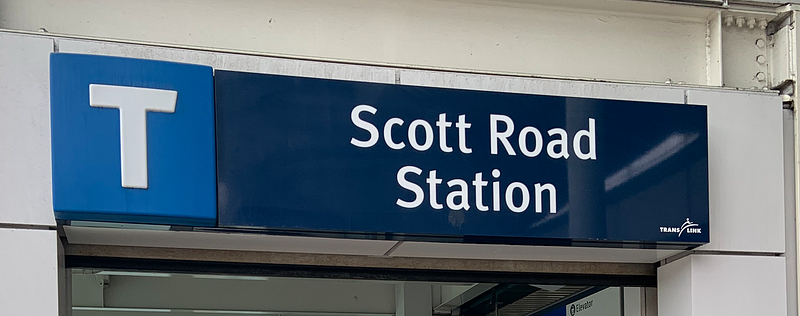
All will tremble as they approach this sign.
After poll after poll, we have finally determined that the worst station operated by TransLink is Scott Road. However, Scott Road was not the only station given negative attention.
None of this should be taken as anything more than my uneducated observations as I don’t really think it’s that important overall. We all know Scott Road sucks!
Engagement and results
As mentioned in the original piece, this was a super-scientific Internet poll where there was absolutely no bias and everyone knows what they are doing.
One big thing: no station tied. I did vote in every poll and would have removed myself or gotten someone to break it had it occurred.
There were 5,455 total votes counted across six rounds. As the polls went on, the engagement did drop, which does make sense considering the number of match ups reducing with each step. Each match up on average had 104 votes, with the opening round having the most at 127 and the third having the least with 59. The final match stood alone of course at 222 total votes.
Losers in each match up (which are really “winners”) tended to get a score of just about 25 points. With exception to the first round which saw an average of about 29 votes, all losers received an average of either 15 or 16. The final loser saw a loss of 56.
Winners (or “losers”) saw stability in the same rounds with the second to the fifth seeing 47, 44, 53, and 66 respectively, but the first saw 98 votes. The winner received 166.
Some close matchups were to be had as well. When Gilmore faced Port Haney in the second round, the resulting score was 27 to 23, pushing Gilmore into the third round.
Then there were some matchups where the outcome was so obvious that it was tempting to break the rules. A good example was where in the first round, Joyce-Collingwood received a meagre 14 votes to Lansdowne’s 115.
The winner of the tournament, Scott Road, averaged 75% of the vote share in each poll, with the worst at 65.7% and the best with 85.7%.
Ranking the worst by round weight
The way data was presented by Challonge made some stations who lost in other rounds as being tied with others. This makes ranks rather awkward as we end up with four stations tied for fifth and eight for ninth with no indication of what sits inbetween.
To combat this, I came up with this idea: we have six rounds, so the first round would give a score a weight of 1/6th, second would be 1/3rd, and so forth until the sixth and final round just being a weight of 1. What we can do with this is then apply this to the scores awarded in each round.
An example would be where Royal Oak had a score of 16 to Gateway’s 29, meaning that it was actually a score of 5.3 to 9.6 due to the match being in the second round. Another would be the first round’s Metrotown’s 52 to Production Way-University’s 189 becoming 8.6 to 31.5.
With this information, let’s rank the top ten worst stations overall using their combined weighted votes.
- Scott Road (319.16)
- Lake City Way (214.16)
- Gateway (103.5)
- Holdom (103.17)
- King George (72.17)
- Port Coquitlam (64)
- Edmonds (48.67)
- Sapperton (47)
- Maple Meadows (43.17)
- Nanaimo (38.84)
Of note for municipalities, we have three stations in Surrey, three stations in Burnaby, one both in New Westminster and Vancouver, and then Port Coquitlam and Maple Ridge each getting in as well. All stations mentioned are on the Expo Line except for Maple Meadows and Port Coquitlam being West Coast Express; and Lake City Way and Holdom being Millennium Line.
If you hate this idea, let it be known that I am not a statistician. The idea I have here is to look at the popular vote and which polls received the most engagement. If you wish to play with the data differently, please do check out the link at the start of the article!
Using the weighted scores on service and line
While the West Coast Express operates on regular locomotives, sharing tracks with freight rail services, the SkyTrain system is completely separate. There are however three stations where both systems do meet as transfer points, with all three SkyTrain lines having connections.
SkyTrain
This system was first introduced in 1985 and has expanded since to provide via three lines.
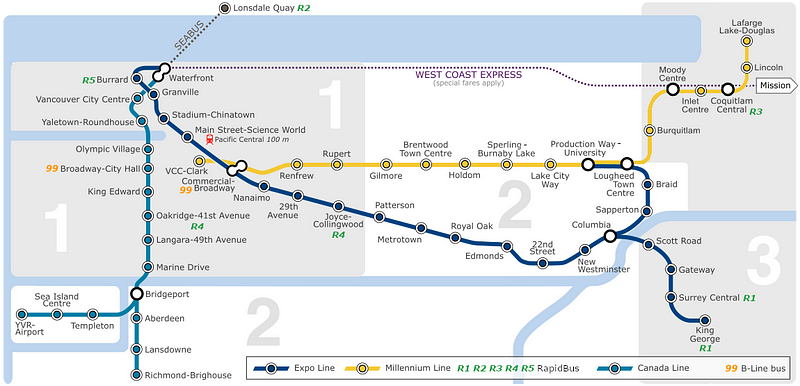
Most of the stations in the tournament are shown here. (Source)
The Expo Line and Millennium Line both use the same technologies and service Vancouver, Burnaby, Coquitlam, Port Moody, New Westminster, and Surrey. The extension of the Millennium Line is the most recent addition, providing service as far east as Coquitlam. Presently, both lines are being extended with the Millennium going further west into Vancouver towards Arbutus Street and the Expo Line terminating to the southeast in Langley.
The Canada Line serves just Richmond and Vancouver and notably provides service to the airport. Unlike the other two lines, it only provides two car trains and has much shorter platforms and is incompatible physically and technologically.
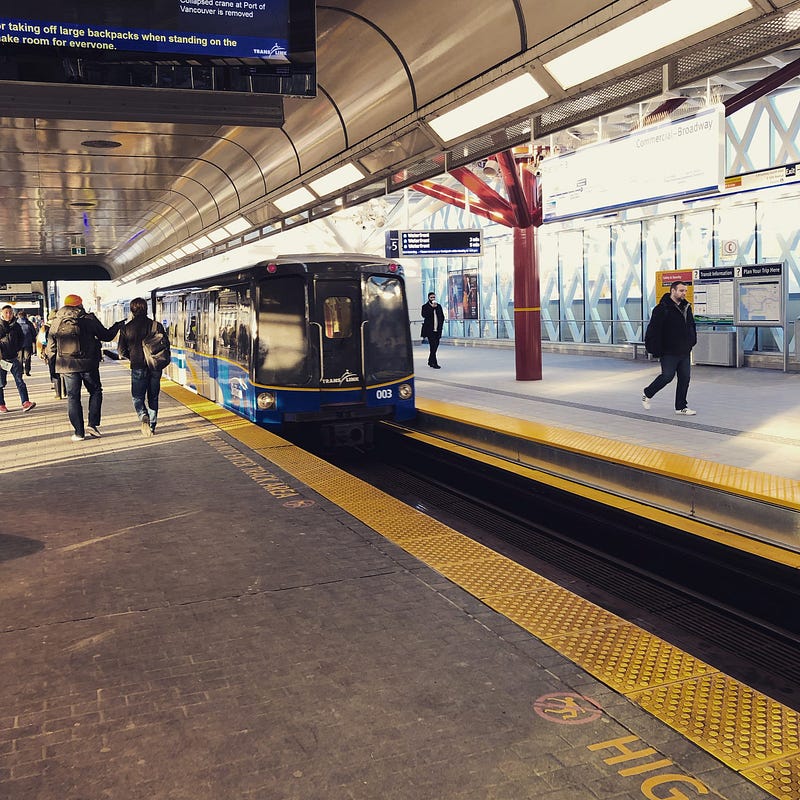
The Expo Line is home to Commercial-Broadway, a station which lets you enter or exit a train on either side.
The Expo Line is home to the winner, Scott Road and also received a score of 32.05. It also received the lowest score for a single station, which will be discussed later.
It ranked as follows:
- Scott Road (319.17)
- Gateway (103.5)
- King George (72.17)
- Edmonds (48.67)
- Sapperton (47)
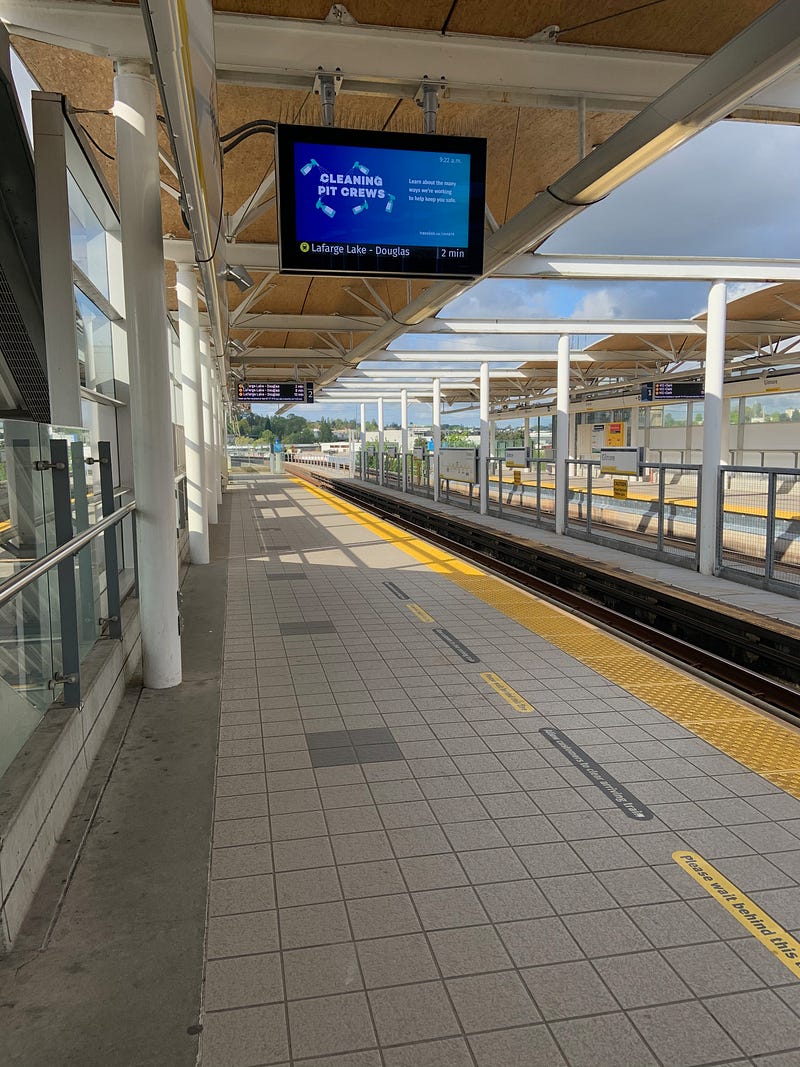
Somehow I only have one photo of a Millennium Line station.
With the Millennium Line, it had the runner up, Lake City Way, and received an average of 35.26. It is home to the youngest of all SkyTrain stations, with the extension to Coquitlam opening in 2016 alongside an upgrade of Lougheed Town Centre as well — all of those new stations plus Lougheed scored 14.67.
- Lake City Way (214.17)
- Holdom (103.17)
- Production Way-University (38.17)
- Renfrew (28.67)
- Gilmore (26.67)
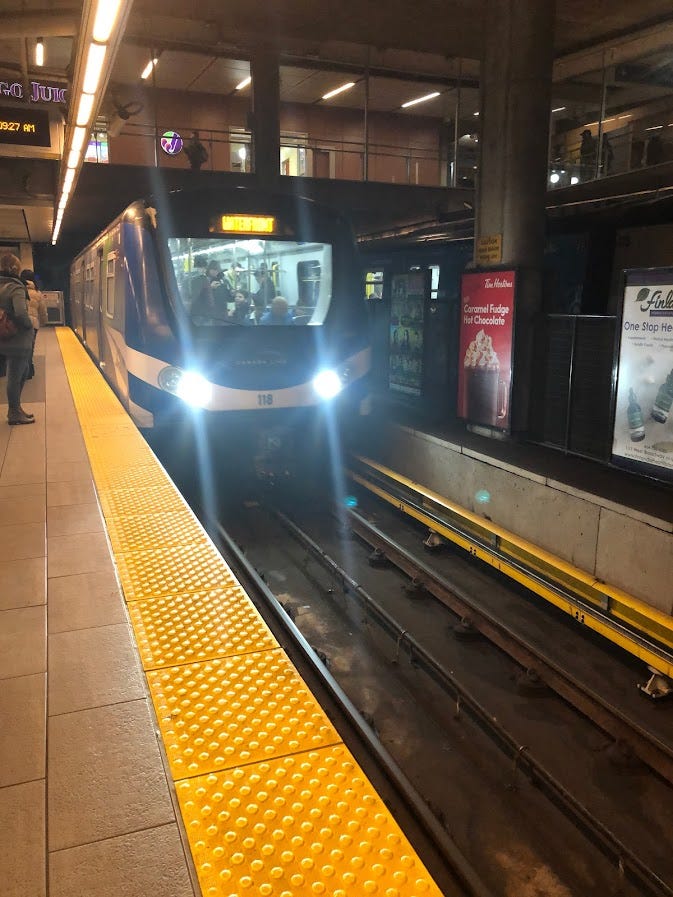
Canada Line trains are wider than their Expo and Millennium Line siblings.
And lastly, the Canada Line, which has its trains physically separate from the other two lines scored 13.04, making it the least disliked of the three lines.
- Richmond-Brighouse (34.17)
- Yaletown-Roundhouse (32.67)
- Templeton (29.17)
- Lansdowne (22.5)
- Aberdeen (19.5)
Overall, SkyTrain received a score of 26.78.
West Coast Express
The service provided by the West Coast Express (WCE) is different from SkyTrain in that it doesn’t provide service throughout the majority of the day and it also is unusual in that it extends outside of TransLink’s jurisdictions with its one station in Mission.
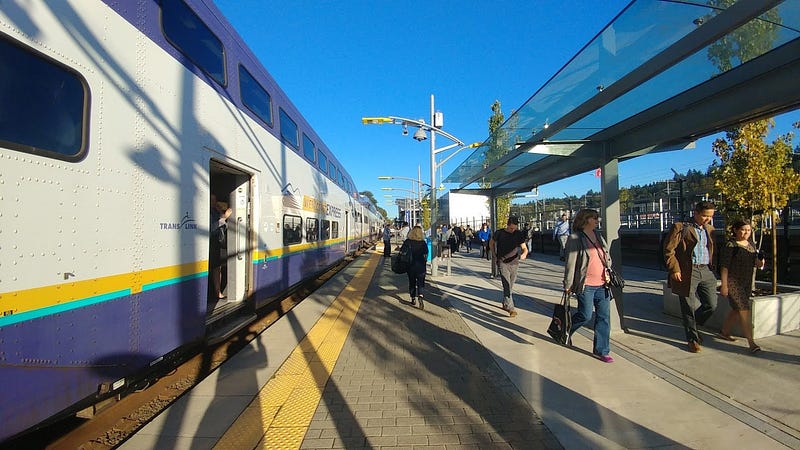
One cool trick about the West Coast Express now is that you may have the option to use it if SkyTrain has problems but isn’t completely down.
Because of it being a commuter rail service with single-direction service in the mornings into Waterfront and in the evenings towards Mission City, its stations reflect that nature by being quite spartan.
It was anticipated that at least one of them would place top-five when I started the polls, but it fell short by only placing sixth after adjusting for weight. Challonge tied two stations for fifth — Maple Meadows and Port Coquitlam — but I am more interested in the weighted score.
Of the eight stations served, three tie in with SkyTrain, which I do believe alters the score quite a bit as there is a larger pool of non-WCE users available to alter the outcome.
With the SkyTrain stations included, we get the following result:
- Port Coquitlam (64)
- Maple Meadows (43.17)
- Pitt Meadows (34.33)
- Coquitlam Central (22.17)
- Mission City (17.67)
Of those above five, only one ties in with SkyTrain, which is Coquitlam Central. Stations without that connection produced a score of 34.8, which makes it score worse than SkyTrain. However, if we add the removed stations back in, the score becomes 25.
Transfer stations
As mentioned with the West Coast Express, many of the stations act as transfer points and the same is true with SkyTrain. With some stations, the service is interlined — such as Production Way-University having a single platform for Expo and Millennium Line trains — and in others, everything is separate — see Waterfront with its Expo and Canada Line platforms and also West Coast Express.
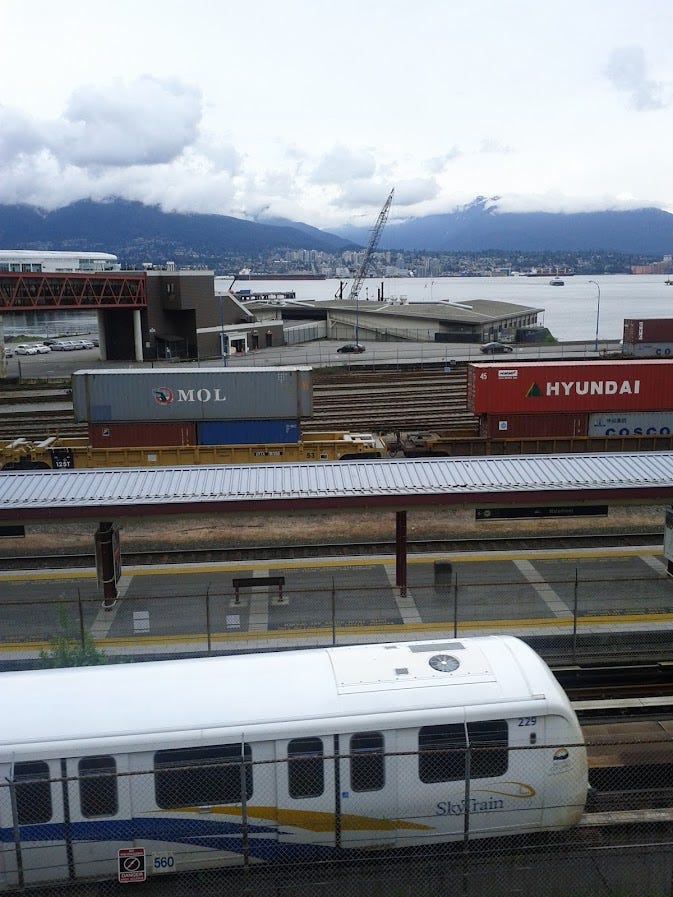
The platform just above where the SkyTrain vehicle is located is about as close as it gets for where the West Coast Express and Expo Line will meet.
I’ve opted to define the transfer points as any station where you must leave the train to go elsewhere without necessarily leaving the station. This would include connections to other lines or the WCE, but it also includes where the line would split into a spur such as what occurs on the Expo Line and Canada Line.
This gives us eight stations to work with, with two shared between the Expo Line and Millennium Line (Production Way-University and Lougheed Town Centre), one shared between the Canada Line, Expo Line, and WCE (Waterfront); two shared with the Millennium Line and WCE (Moody Centre and Coquitlam Central), one each on the Expo Line and Canada Line (Columbia and Bridgeport).
It ends up looking like this:
- Production Way-University (38.17)
- Columbia (35.17)
- Coquitlam Central (22.17)
- Bridgeport (15.5)
- Commercial-Broadway (5.5)
In reviewing Production Way-University, which is shared as a terminus station for the Expo Line and a regular station on the Millennium, it was interesting how it scored so poorly considering it didn’t make it past the second round and had only one comment about its lack of available escalators.
Columbia did make it into the third round and ultimately lost to Scott Road, but had received less votes. The complaints were all focused on it being a terrible transfer point as the stations two separate platforms means it is very difficult to make a quick transfer.
Overall, transfer stations received a score of 15.6.
Ranking by municipality
Using the weighted votes we determined earlier, we can determine how individual municipalities fared.
Vancouver
Stations within the city limits received an overall score of 10.87. It is the only municipality with all three SkyTrain lines and West Coast Express service.
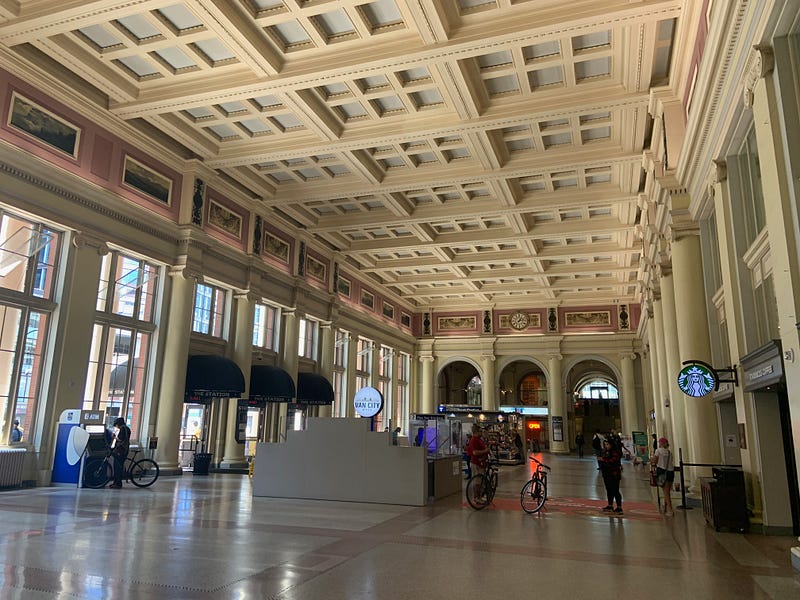
One day I will write about my love affair with Waterfront.
Notably, the original SkyTrain station, Main Street-Science World received the lowest score of 0.83, making it the last-disliked station in the tournament.
- Nanaimo (38.83)
- Yaletown-Roundhouse (32.67)
- Renfrew (28.67)
- Rupert (23.17)
- Broadway-City Hall (12.33)
With the upcoming interchange at Broadway-City Hall, this score could change should this tournament run again.
Burnaby
This city was host to the runner up, so it is easy to determine which would place first. The scoring average here was 47.85.
- Lake City Way (214.17)
- Holdom (103.17)
- Edmonds (48.67)
- Production Way-University (38.17)
- Gilmore (26.67)
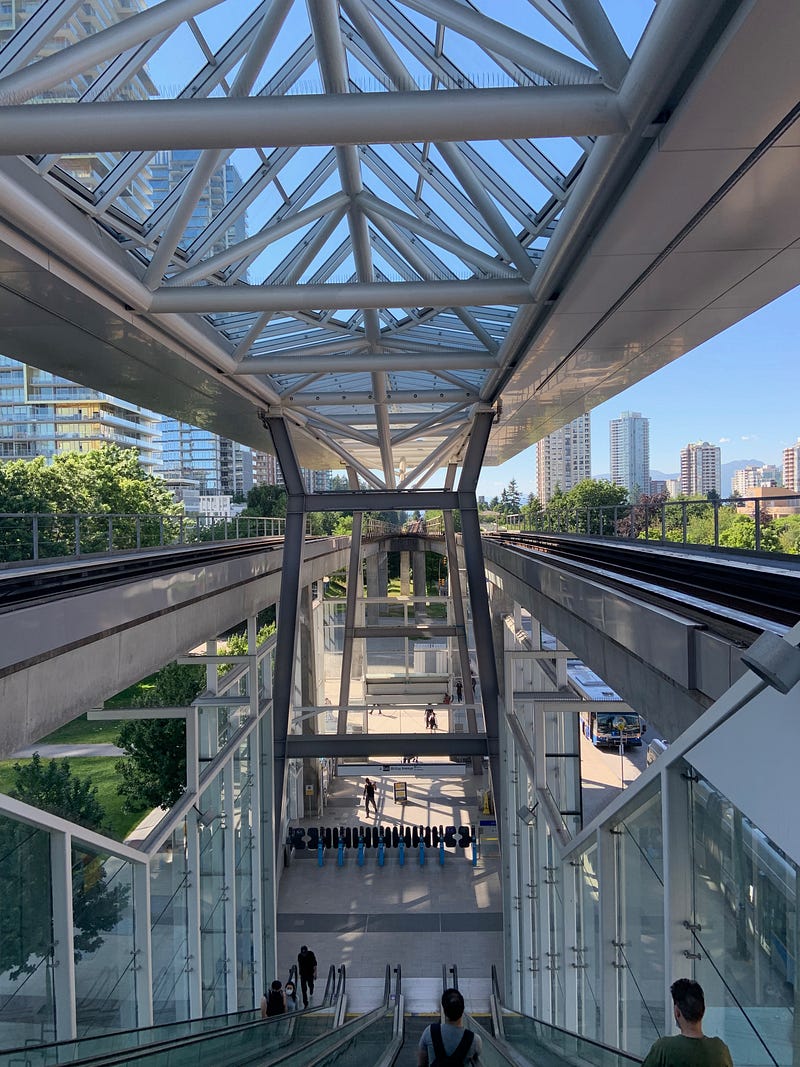
Escalators are plentiful at Metrotown which isn’t easy to be said for most stations.
Expansion of rapid transit in Burnaby isn’t in the near future, but I am curious to how Brentwood Town Centre’s changes will have an impact on things.
Richmond
Richmond only has a single line (Canada Line) entering its city limits and is home to Vancouver International Airport, which is one of the two termini for the city. Its stations received average score of 19.9.
- Richmond-Brighouse (34.17)
- Templeton (29.17)
- Lansdowne (22.5)
- Aberdeen (19.5)
- Bridgeport (15.5)
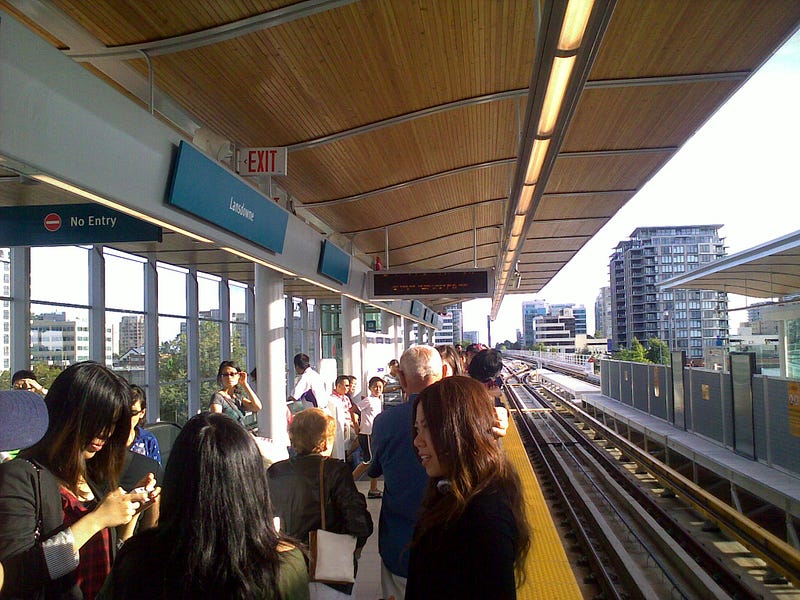
On its first day open to the public, it was free to ride and I happened to be in Richmond at the time.
The city will receive its newest station, Capstan Way, in 2023, which will sit between Aberdeen and Bridgeport.
Tri-cities and elsewhere
The tri-cities (Coquitlam, Port Coquitlam, and Port Moody) plus Maple Ridge, Pitt Meadows, and Mission do not have enough stations to make a top five list each — Mission is also the only station completely outside of TransLink’s jurisdiction.
Combined, they received an average score of 19.24, but for the municipalities which have more than two stations (which is just Coquitlam and Port Moody), it changes. Port Moody with its two stations received an average of 2.83 and Coquitlam scored 17.5. Both municipalities each have one station which provides connecting service to the West Coast Express — Moody Centre and Coquitlam Central.
- Port Coquitlam (64)
- Maple Meadows (43.17)
- Pitt Meadows (34.34)
- Burquitlam (23.5)
- Coquitlam Central (22.17)
There are no plans to expand service further eastward for SkyTrain services although there are design considerations for it in place.
Surrey and New Westminster
With New Westminster having exactly five stations and Surrey just having four, it was given the thought to combine their stations into one list. However, the roles and areas the stations serve are different and it didn’t feel right to combine them as one list.
While Surrey did have the worst station and a high average score of 125.84, it did also have one of the least-hated stations with Surrey Central scoring 8.5, placing it 33rd out of 50 — many stations had tied despite the weights.
The challenge with this score is that the city does not have that many stations and it doesn’t extend as deep into its borders as elsewhere in the tournament, with this of course changing in the next few years.
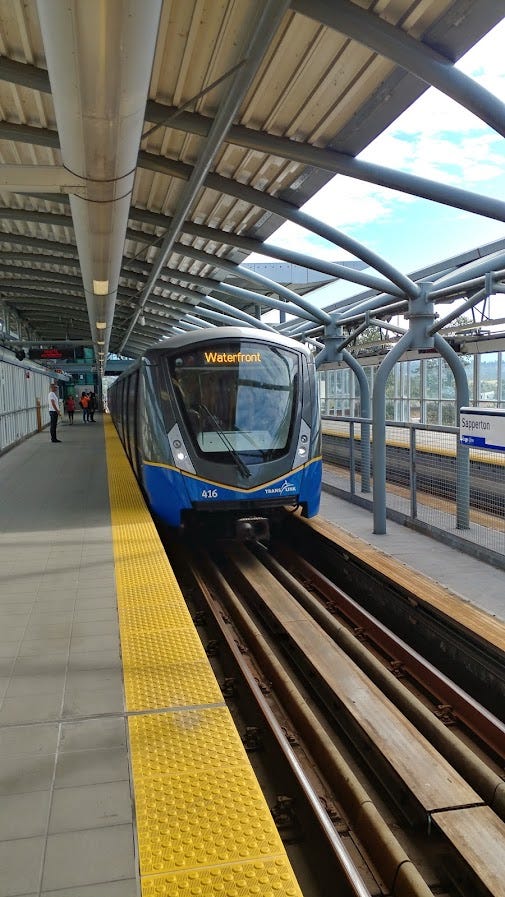
At one point in their lifetimes, both Sapperton and Braid stations were exclusively Millennium Line stations.
New Westminster’s least favourite station, Sapperton received a score of 47, with Columbia getting 35.17. The average for the city was 23.17. Like Burnaby, there are no real major changes in the city’s future with perhaps upgrades to Columbia, proposed to alleviate its problems with being a transfer point for the Expo Line spurs.
I hate these numbers!
That is okay! So do I! Midway through writing this article, I wanted to talk more about the percentages rather than the weights, but I was already pretty tired of staring at spreadsheets and data. If you’re interested in playing with the data yourself, I have a separate piece you can read!
-
Data from the Worst SkyTrain/West Coast Express Tournament
If you have not read my previous piece on Scott Road being the worst SkyTrain station, I suggest giving it a read first as it will help give better context to the data here.
From late-June until the end of July, I ran a tournament to decide which of the stations on the SkyTrain and West Coast Express systems is the worst. Here is the data if you are at all interested in taking a look.
Challonge data
Challonge does not provide an API, but it did deliver the data via JSON, which is then rendered by the browser locally.
You can view the data I extracted here, which was sourced from this page.
Facebook polls
Assuming you have access to the Facebook group, you should be able to see each poll from these links.
The numbers in parenthesis are the scores they received at the time a snapshot was made. It is likely that some of them have changed since but they’re not reflected in the data provided earlier.
Round 1
Metrotown (52) versus Production Way–University (189)
Nanaimo (95) versus Lougheed Town Centre (27)
Inlet Centre (23) versus Aberdeen (85)
Braid (44) versus Columbia (106)
Main Street–Science World (5) versus Mission City (70)
Sea Island Centre (73) versus Scott Road (140)
Coquitlam Central (115) versus Granville (57)
Commercial–Broadway (33) versus Burquitlam (131)
Pitt Meadows (56) versus Oakridge–41st Avenue (14)
Lansdowne (115) versus Joyce–Collingwood (14)
Gateway (85) versus 29th Avenue (13)
Gilmore (85) versus Surrey Central (51)
22nd Street (19) versus Port Haney (43)
Brentwood Town Centre (43) versus Broadway–City Hall (56)
Bridgeport (75) versus Burrard (31)
Waterfront (12) versus Holdom (142)
New Westminster (19) versus Rupert (111)
Moody Centre (11) versus Edmonds (61)
Sapperton (78) versus Stadium–Chinatown (28)
YVR–Airport (38) versus Yaletown–Roundhouse (116)
Port Coquitlam (83) versus Olympic Village (23)
Marine Drive (27) versus Renfrew (120)
Richmond–Brighouse (99) versus King Edward (34)
Templeton (100) versus VCC–Clark (33)
Patterson (102) versus Lafarge Lake–Douglas (19)
Lake City Way (90) versus Langara–49th Avenue (18)Round 2
King George (96) versus Production Way–University (20)
Nanaimo (30) versus Aberdeen (16)
Columbia (27) versus Mission City (18)
Scott Road (54) versus Coquitlam Central (9)
Maple Meadows (46) versus Burquitlam (5)
Pitt Meadows (42) versus Lansdowne (10)
Royal Oak (16) versus Gateway (29)
Gilmore (27) versus Port Haney (23)
Lincoln (50) versus Broadway–City Hall (9)
Bridgeport (9) versus Holdom (59)
Rupert (14) versus Edmonds (30)
Sapperton (72) versus Yaletown–Roundhouse (40)
Vancouver City Centre (9) versus Port Coquitlam (53)
Renfrew (26) versus Richmond–Brighouse (35)
Sperling–Burnaby Lake (16) versus Templeton (27)
Patterson (15) versus Lake City Way (78)Round 3
King George (59) versus Nanaimo (26)
Columbia (17) versus Scott Road (42)
Maple Meadows (37) versus Pitt Meadows (22)
Gateway (43) versus Gilmore (7)
Lincoln (10) versus Holdom (63)
Edmonds (33) versus Sapperton (20)
Port Coquitlam (41) versus Richmond–Brighouse (12)
Templeton (7) versus Lake City Way (33)Round 4
King George (16) versus Scott Road (65)
Maple Meadows (14) versus Gateway (56)
Holdom (35) versus Edmonds (18)
Port Coquitlam (18) versus Lake City Way (56)Round 5
Scott Road (57) versus Gateway (25)
Holdom (6) versus Lake City Way (76)Round 6
-
The Worst SkyTrain Station is Scott Road
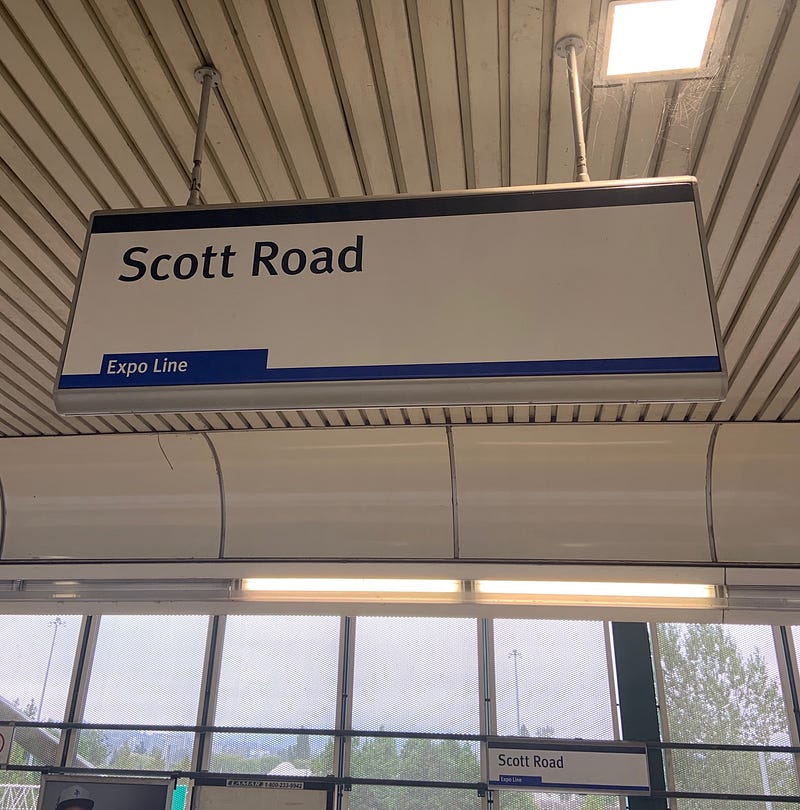
If you have gotten off your train and are seeing this sign, you probably know why it is a bad station without having to read a Medium piece about it.
One of the questions that is easy for me to answer is my favourite SkyTrain station, but the more difficult question is what is my most-hated.
The answer to my favourite won’t be provided in this article, but it is rooted in my ability as a person, my commuting patterns, and where I live. This means that I cannot give an objective answer to a good or bad station because my needs and uses are different from everyone else.
So how did I determine the worst SkyTrain station? Well, after being unable to come to a conclusion after a conversation with friends, I embarked on crowdsourcing the answer using a tournament bracket.
Asking ELMTOTs about every station in the SkyTrain and West Coast Express network
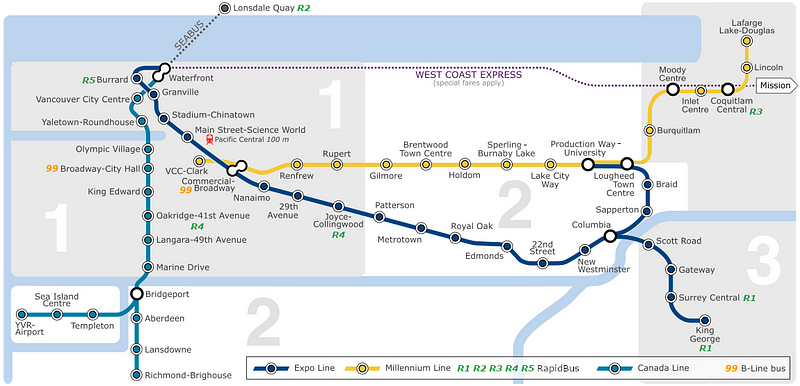
SkyTrain and West Coast Express network as of 2021 (Source)
SkyTrain consists of a handful of automated metro lines, with 53 stations spread across a total length of about 80 KM. The West Coast Express (WCE) provides commuter rail services to eight stations along 69 KM of shared track, with three of them sharing connections to the SkyTrain network itself.
Because of the unevenness of the number of stations provided in the present-day SkyTrain network, WCE stations were included to make it easier to run a tournament bracket. The thought was that since both are operated by TransLink (the parent agency) and were both rail services, it was fair to have them scrutinized.
Expo Line Memes for TransLink Oriented Teens (ELTMOT), is a Facebook group where transit users can come together to chat about what they like or dislike about the network, share memes, and in my case, provide a “very scientific” tournament where each member of the group were invited to help select the worst station.
With the tournament, there were six rounds. In each, a separate poll was posted for each match-up of two stations. With one vote per person permitted and three days passing, a winner (or “loser”, I guess) was decided. The station with the most votes went on to the next round and this kept repeating until the finals.
Some stations did not appear until the second round, but the way the tournament was organized was done at random, avoiding any potential for bias when the list was given to the bracket software.
There were dozens of posts made of which admittedly was a lot more work than I had expected. Somehow I managed to endure the 43 C heat dome at the onset of the poll too, but I was determined (or stubborn) enough to keep it going as it was a question requiring an answer.
From June 21st to July 27th of this year, the voting kept going. After so many posts and data entry, the worst station was crowned as the winner.
So let’s talk about the winner and also let’s pay it a visit.
What did everyone say against the station?
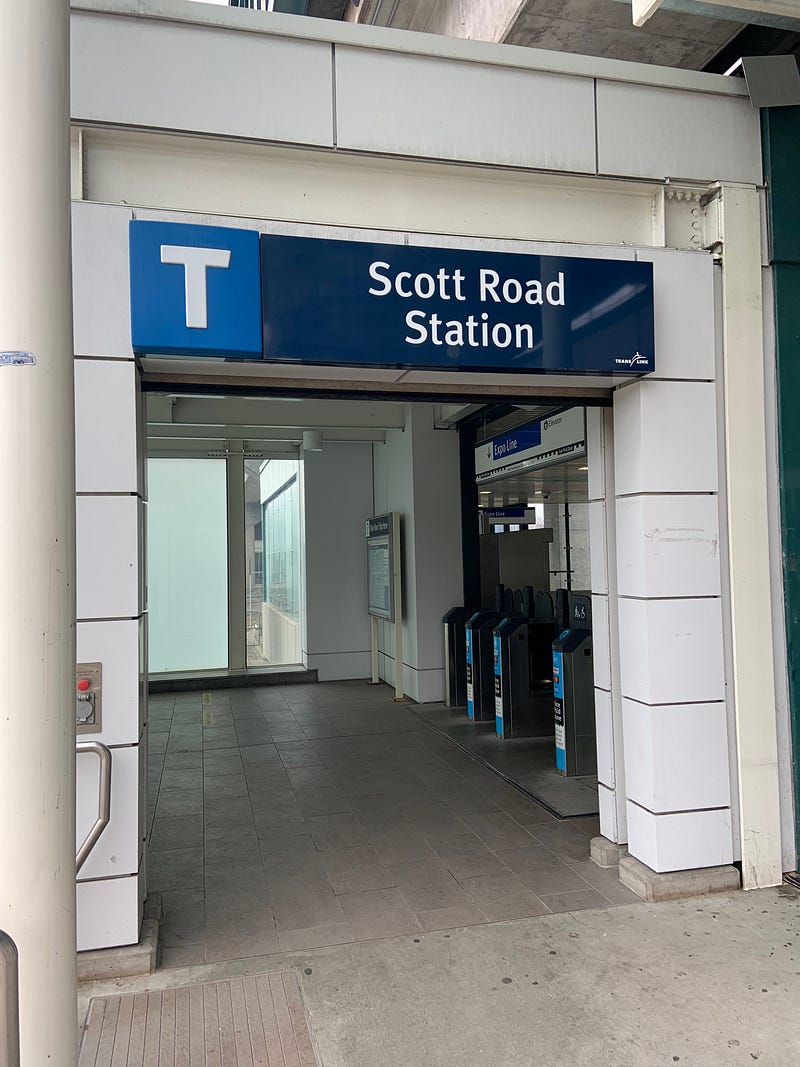
In 2019, 3.3 million people had to endure seeing this sign.
I have collected a few quotes from various ELMTOT members and have included them here.
“Scott Road Station is objectively … not a good place to be.”
“If you walk from Scott Road Station to Brownsville Park via the parking lot, you get stuck in the middle of a highway so that’s cool.”
“Scott Road is such a depressing station. Nothing interesting, nothing remotely aesthetically pleasing, It’s just sadness.”
“Wanna run all the way across a parking lot and then cross a road with no sidewalks and horribly placed crosswalks to get to a McDonalds”
“I hate Scott Road Station personally because for a couple years on Sundays as a teenager, I would miss the 312 [bus route] by a few minutes and end up waiting there an hour. Nothing to do, nowhere to pee, phone battery at 4%… fuck Scott Road Station.”
One person did defend the highway connections and available parking, but overall the impressions of the station were negative.
Okay. So why specifically is Scott Road so bad?
The last time I visited this station was probably in 2008 when my then girlfriend and I chose to cross the Pattullo Bridge on foot at 11:30 PM at night to get back to my home via Scott Road Station instead of walking to the reasonably close Columbia Station, which would have taken just ten minutes.
I can remember getting off of the bridge after a twenty minute walk, with her and I being completely unsure about how to get to the station despite it being in eyeshot. The were fences in the way, resulting in a need to figure out where to cross. After some trial and error, we managed to get into one of the parking lots and boarded a train to Surrey Central.
She and I were both in our twenties then and it was one of those decisions you make because you like red wine too much. However, I am now in my thirties, no longer with said girlfriend, and additionally don’t like red wine anymore, so a sober trip to the station was in order with only a short walk from my home to a nearby station.
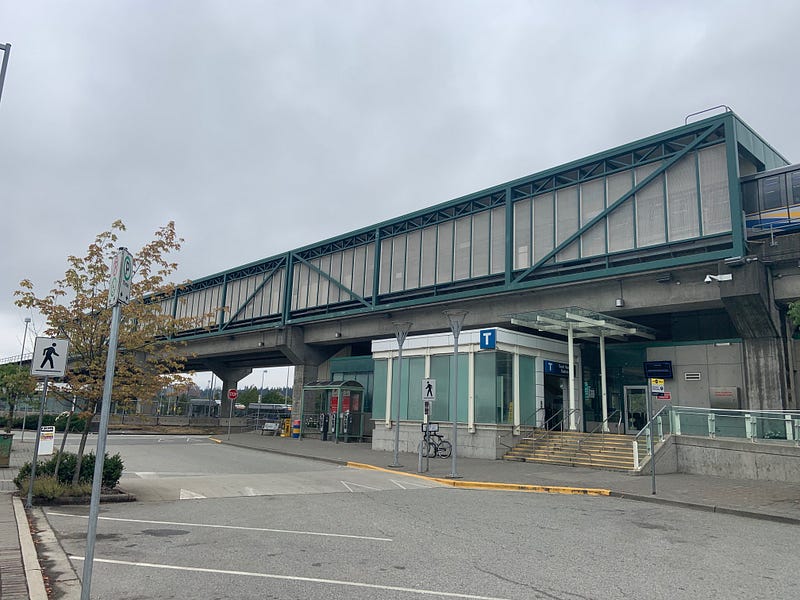
Scott Road Station on a gloomy August day.
Scott Road is Surrey’s oldest SkyTrain station and for a few years was the only station south of the Fraser River. It sits prominently above Scott Road itself, which is the crux of its issues.
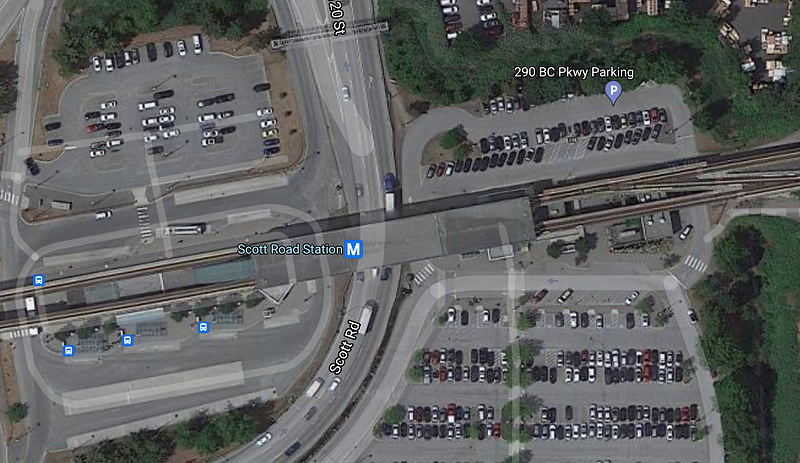
Scott Road Station as viewed from space (Google/Maxar).
The road, Scott Road terminates just to the east of the station as it meets with King George Boulevard via an interchange, with north access leading to New Westminster via the Pattullo Bridge and south access towards Surrey’s city centre.
The interchange itself should be indicative enough of how pedestrian unfriendly the area is, but it is even worse than that because the road does mean you cannot go from one part of the station’s outside services to the other without having to go into the station itself.
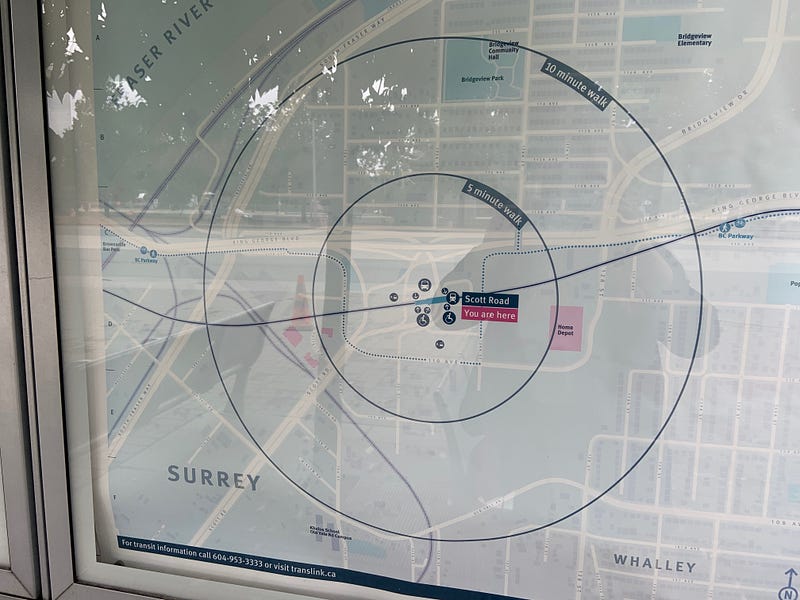
TransLink’s provided map for what is “walkable” around the area demonstrates the underwhelming amenities you could get to by foot unless you really want to visit the nearby Home Depot. Also, you cannot really make a five minute walk to anything to the east of you unless you like playing an augmented reality version of Frogger.
Upon exiting a train, you have three options for available services: a bus loop and a car lot on the north end, and another car lot on the south end. This is extremely confusing.
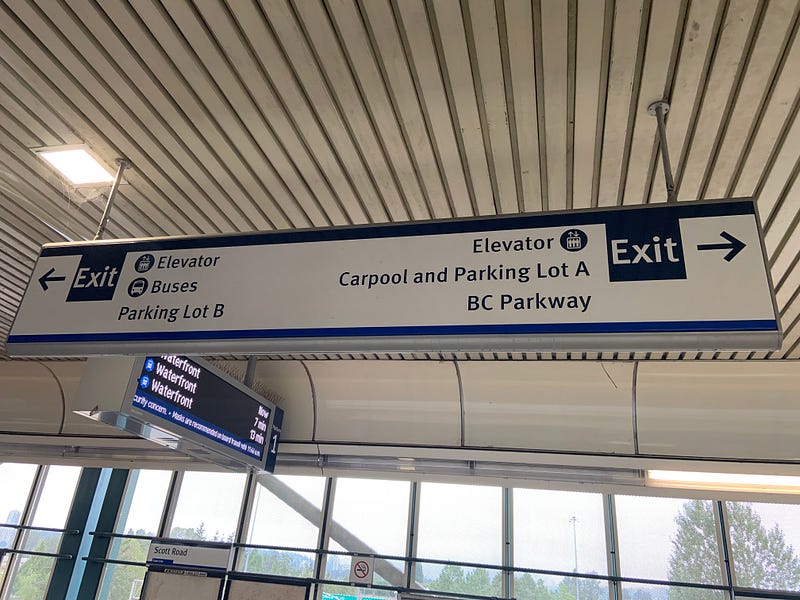
Two exits lead to two identical parking lots and only one takes you to a bus.
The confusion about the two parking lots stems from how this station was first designed: it was meant to be a park and ride. Cars would drive to the station and either park there or would wait to pick up any departing passengers.
If you got off here during the era where your mobile phone did not have instant messaging, you’d have to ensure ahead of time that your awaiting car was in the correct location. This is less of an issue these days, but assuming everyone has a mobile phone which permits this functionality is problematic.
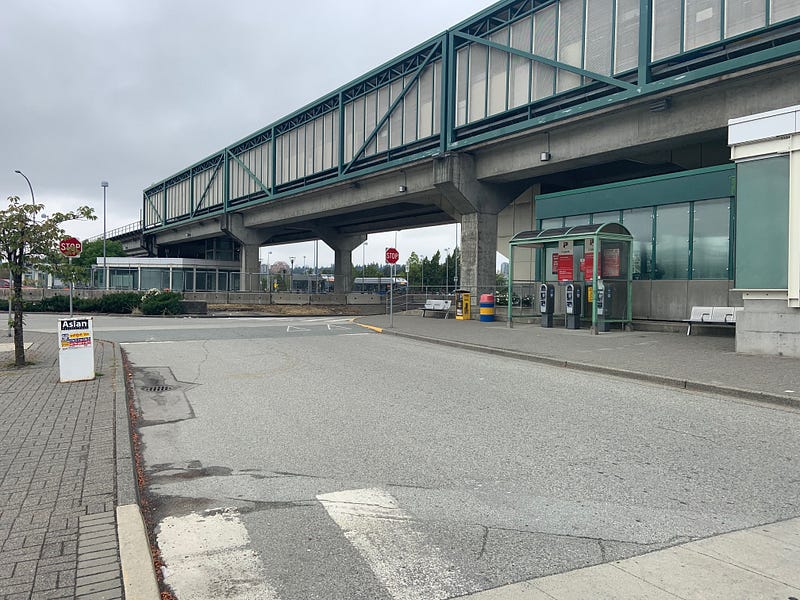
Over here in parking lot B, you better hope you’re not getting picked up from parking lot A because you will be going back inside. If it is past 1:10 AM on a weekday, you’re going to be walking for a while.
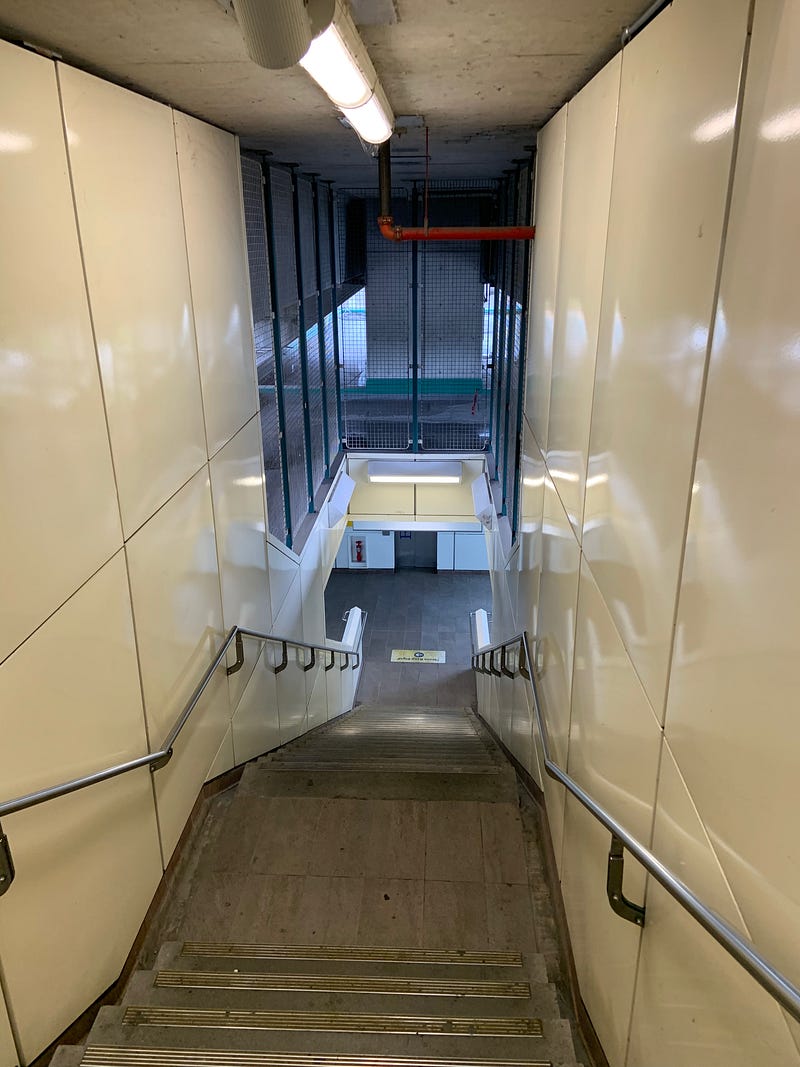
With design aesthetics lifted from an aging BC Ferry, you probably became quite familiar with these stairs when you figured out your ride is waiting on the other side.
The station is a product of its time and is in dire need of being fixed.
As someone put it to me while we were at the station: it’s a station I didn’t know about until today and it is also a station I wish to never visit ever again.
What future is there for Scott Road?
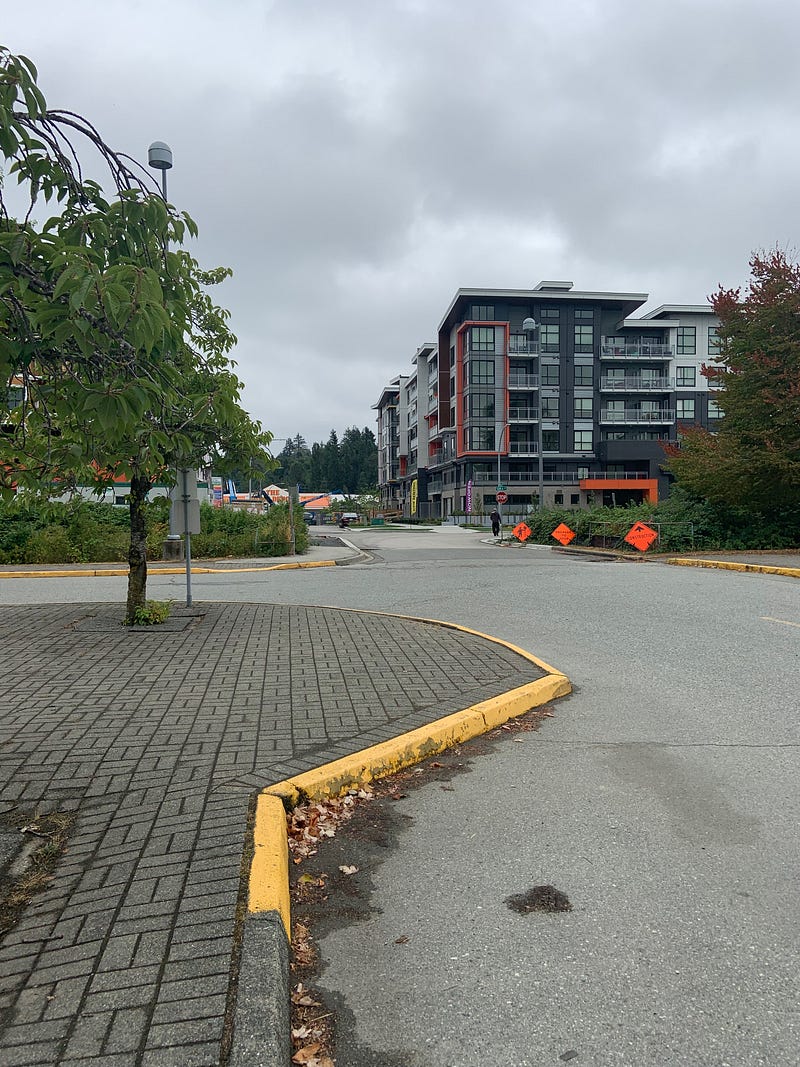
While there is the TransLink-endorsed, walkable Home Depot in the distance, there is also now rental housing within a thirty second walk from the station’s south entrance. New housing is under construction all around the area and it is likely to become less of a commuter destination and instead an actual neighbourhood.
The land around Scott Road Station is amongst the the easiest to develop in Metro Vancouver. While there are arguments against the removal of parking stalls around stations, the region has been shifting away from park and ride arrangements and instead towards expanding rail and rapid bus services and developing amenities.
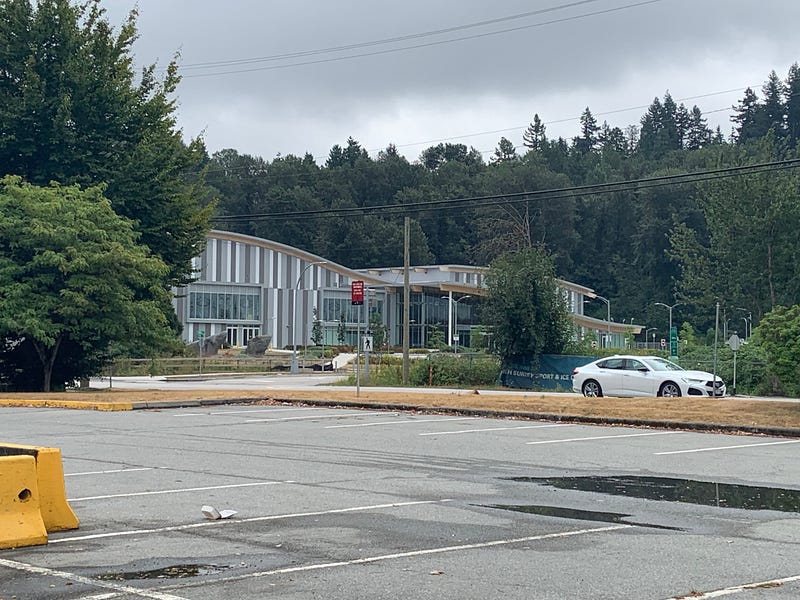
The new North Surrey Sport and Ice Complex was built atop of grounds once used for parking at the station.
The station itself has also been undergoing upgrades with escalator replacements and has had its elevators improved. There are no long-term plans to add extra transit services to the station, but it isn’t hard to imagine this station being a hub for commuter rail or rapid rail service servicing areas such as North Delta.
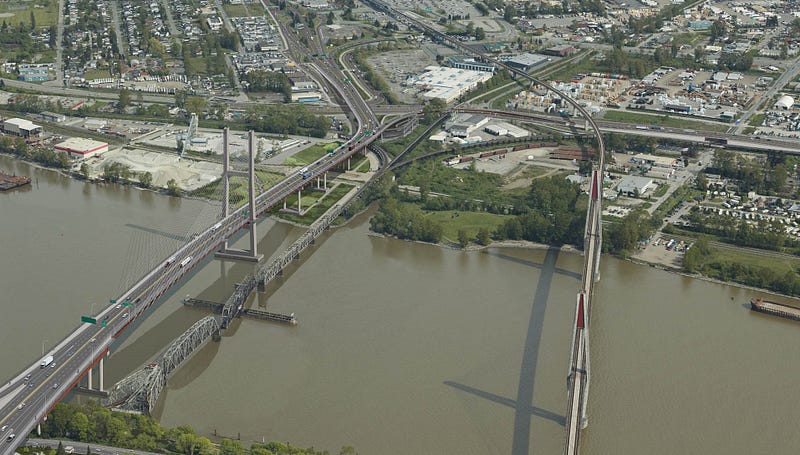
Rendering of the new Pattullo Bridge with Scott Road Station towards the top (BC Government).
Unfortunately, a missed opportunity for the Pattullo Bridge replacement project is the whole Scott Road Station pedestrian situation. None of the renderings show an improvement even with the better connections from the bridge to Highway 17.
Considering the better connection to the highway from the new bridge, it may make Scott Road a much gentler road itself, but the arrangement does not appear to immediately suggest this.
What about other stations?
As mentioned before, all WCE and SkyTrain stations were evaluated.
As with all Internet-based polls, this project of mine was super scientific and free of bias, requiring zero peer-review. The results are concrete and completely infallible evidence of the general population’s opinions.
Thanks to science, we have details on who the runner ups were.
Lake City Way (Millennium Line)
This station was the runner up to Scott Road as it lost in a score of 166 to 56 in the final round. The arguments made for the station being the worst was that it was a rather unremarkable station, with not much around it other than industrial buildings and some homes within walking distance.
Maple Meadows (West Coast Express)
Surprisingly, West Coast Express stations didn’t get a lot of hate. The consensus about this station in Maple Ridge was simply how far away it was from everything else nearby. This station placed fifth overall in the tournament.
Templeton (Canada Line)
Simply put: a giant parking lot and a shopping centre. If you’re getting on here, you are probably parking your car to go to the airport as nobody seems to use the station to go buy clothes at the nearby outlet stores. It placed ninth.
Closing
After the Pattullo Bridge’s construction has concluded and with the upcoming extensions of the Millennium Line deeper into Vancouver and the Expo Line towards Langley, it may be worth revisiting this question: which station is the worst?
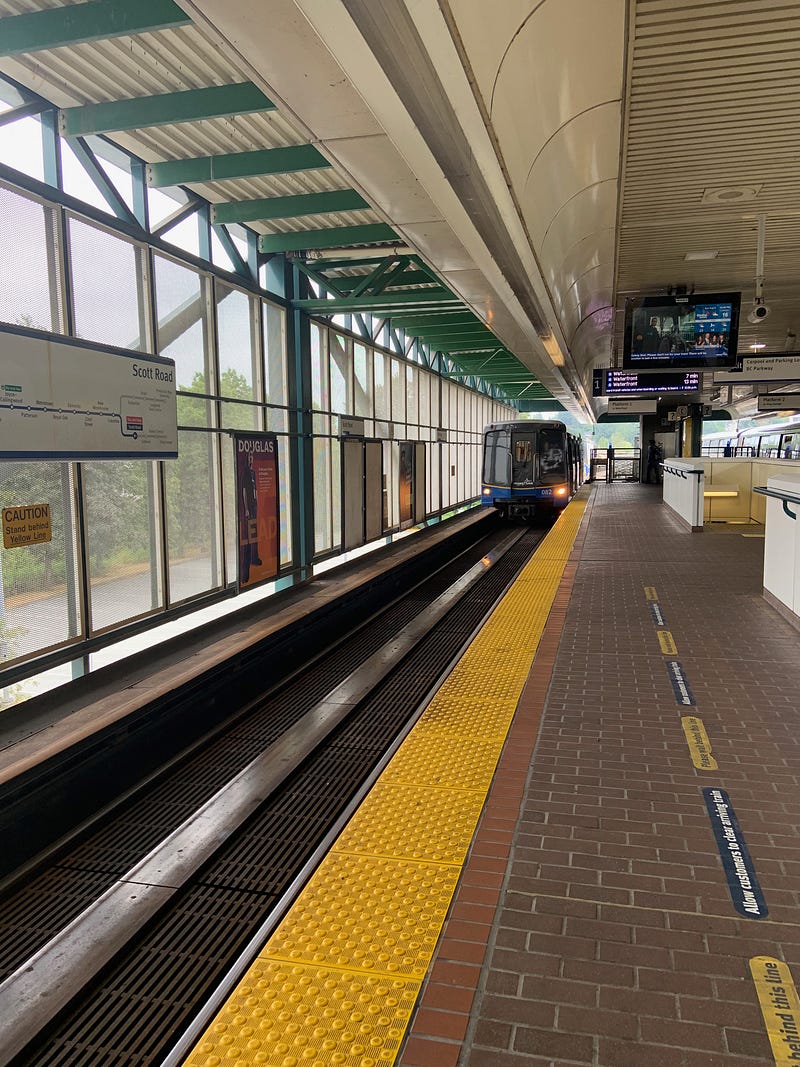
Taking the train home, which is far, far away from this terrible station.
Perhaps in 2031, we’ll be able to talk about the worst station again and maybe then the crown will be given elsewhere.
-
Looking back at the Game Gear after having played most of its library
Back in early 2020, I embarked on an ambitious plan: I was going to play every non-RPG and non-sports game lineup on the Sega Game Gear.
At the start, it didn’t seem so bad as I figured it would be on par with playing games from the Nintendo Game Boy library, but Sega’s portable console was not only good at eating up batteries, but it was capable of frustrating me in ways I didn’t anticipate.

The Game Gear logo, proudly demonstrating it can do red, blue, and green.
Hyperbole aside, the Game Gear is overall an awful system, but the reasons for why it is awful became evident the more often I’d spend a Monday night entertaining folks on Twitch with a new crop of games that would find themselves often labeled as “cursed” or “jank”.
An overview of the darn thing
The Game Gear itself is a technical masterpiece for its time. Comparatively similar in specifications to its Nintendo counterpart, its origins were in Sega’s earlier console, the Master System as it was effectively a portable version of it albeit with a different screen resolution. Unlike the Game Boy, it featured a palette which offered thousands of colours (4,096) with 32 of them on screen at any given time instead of four monochromatic shades of grey atop of a green backdrop.
Yet despite Sega promoting the handheld’s graphical superiority over its competition, it could not muster more than one sale for every ten that Nintendo made. Reasons for this were numerous, but it is wise to suggest that it was probably because of the six AA batteries required to operate it with a maximum runtime of three hours. The colour screen came at a cost because the Game Boy could use four of the same batteries and be able to provide a playtime on them of five to ten times as long. The Sega console was 50% more in price too, making it not palatable to parents.
That all aside, an impressively large library did manage to develop for the console with just over 360 titles being released worldwide, with somehow North America having more games than Japan.
What was actually good
Okay. So I started this off all negative, but honestly there were a few things good about the Game Gear. One of the things that made the Game Gear have a large library was that many of the games already existed on the Master System (SMS) and with very little tweaking, they could be made to play on the handheld.
In fact, just like the Sega Genesis/Mega Drive, there are adapters available (albeit from third-parties) which enable plugging in SMS cartridges directly into the handheld.
My first speedrun: Kingdom Hearts 0 — “Jorts Before Breakfast”
The Game Gear gave me my first-ever speedrun game:Legend of Illusion Starring Mickey Mouse. This game was interesting for two reasons: the first being that it was ported from the Game Gear to the SMS for Brazilian customers and the second was that it was a Disney game that I actually enjoyed outside of Kingdom Hearts.
I last played it for GDQ Hotfix back in March 2021
It now has a place in my heart as a game that I would have otherwise ignored if I didn’t embark on exploring this console’s library.
An amazing port of a game that has no business existing on the platform
Did you know that a competent port of Panzer Dragoon was ported to the console? Panzer Dragoon Mini was a Japan exclusive and while it was not entirely great to play in contrast to its Sega Saturn counterpart, I didn’t think it was as bad as it could have been.

It played as well as well as it could for a third-person perspective-style game.
I didn’t finish it but I did get fairly far. It is not a game I wanted to continue playing again, but it stood out as rather impressive from a technical perspective.
I am biased here, but a licensed anime game was actually good
If you know me personally, I am a huge Sailor Moon fan. I’ve rewatched the original anime series twice, read the manga, seen the movies, and at some point I’m going to get a tattoo of an item from the series.
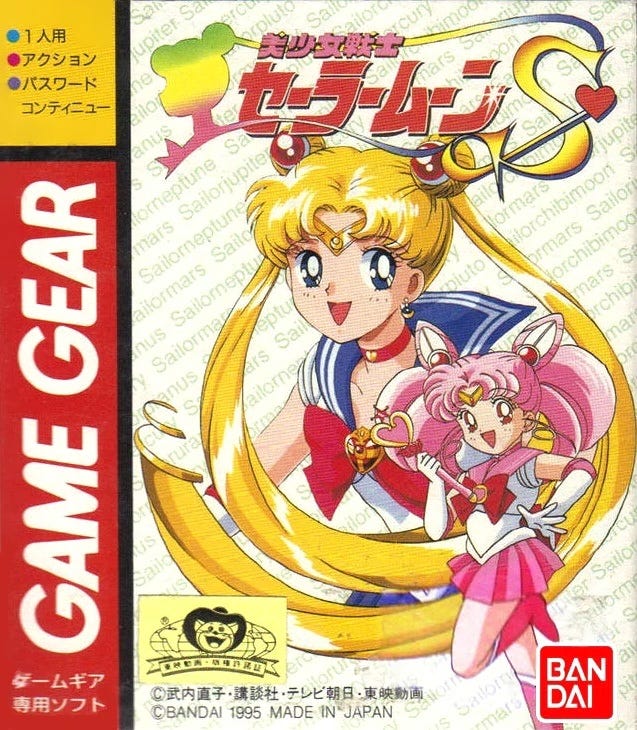
Box art from Sailor Moon S for Game Gear
More often than not, Sailor Moon games are awful, especially when they’re platformers (the Nintendo DS game exclusive to Italy comes to mind). Of all of the games I’ve played, the Game Gear one, Pretty Soldier Sailor Moon S is one of the better ones. Nowhere in the game does it feel like an environment Sailor Moon would actually be portrayed in, but at the same time, it was playable and importantly, enjoyable.
Games that were just awful
Okay. Now I can talk about the negatives. I could run through all of the ones that I hated, but I have opted to just narrow it down to three just so it seems even-handed.
Before I do, the Game Gear is really limited by just having a directional pad, two action buttons, and a start button — it has one less button than the Game Boy, which is used for ‘Select’.
This made attempts to port fighting games which rely on having at least three action buttons (and ideally four to six) fraught with compromises which should have been enough to suggest that they didn’t bother in the first place. This basically is me implying that I won’t bother remarking on a specific fighting game as with exception to one Mortal Kombat port, they were all just bad and played a role in my not bothering to complete my challenge.
I am hearing-impaired and I wish I were more impaired before this
I gave Chicago Syndicate a try, which is an arcade-style beat ’em up. This game was probably the first one to ever make me give up really quick.
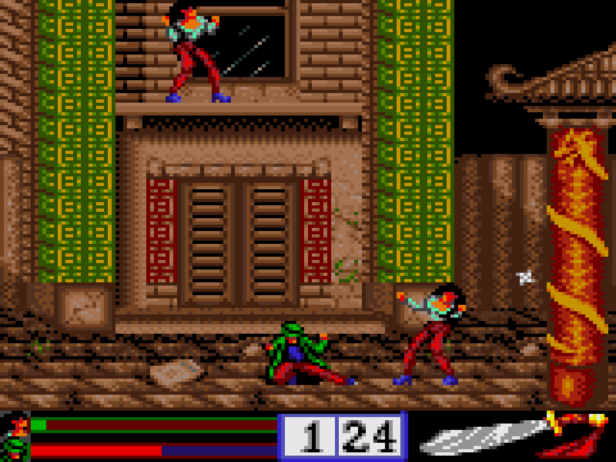
This game was ridiculously slow-paced and could make your ears bleed.
The problem with the game wasn’t the fact that it was slow-paced and felt obtuse in design, it was the fact that my ears were being assaulted with what felt like someone decided a referee’s whistle was a musical instrument (or a smoke detector I guess).
I want to use more colourful words to describe this, but the slow pace and the assault on my ears made me absolutely abhor the short time I gave to this game.
A movie that killed a genre also had a video game tie-in that sucked
Cutthroat Island was suggested to have killed the pirate movie genre for almost a decade when it managed to achieve box office results a tenth of what it cost to produce. It came as no surprise that the video game tie-in for the handheld was not much better.

This is basically it — this is the game
This was probably the first game I labeled as “jank” and it really is as much. When you see the awesome fight scenes in Pirates of the Caribbean (which revived the genre post-Cutthroat), you expect fast-paced action and an expectation that you have no idea where the fight will go. However, this game manages to combine sword fighting with swimming in molasses all the while providing controls that make it feel like you’re eating ice cream with chop sticks.
This game has been put into a special list for other projects to say the least.
An EU game that fortunately remained in the EU
One of my favourite comics and cartoons growing up was Tintin. As an adult, I have a lot of thoughts and feelings on the series and the author, Georges Remi (“Hergé”), but for now, I want to talk about Tintin [in] Tibet.

This is all you’re going to see in this game because good luck getting past the start.
The game is unnecessarily hard from the start. Controls were stiff and you’re immediately presented with platform jumps that just become obnoxious and difficult to achieve. You’re greeted with instant deaths because there’s just no margin for error. At release, French-language publications didn’t give it favourable reviews and I can most certainly understand why.
What about The Hedgehog?
I don’t like the Sonic games on the Game Gear much at all, but I especially disliked Sonic 1 and 2 for one reason and one reason only: resolution.
The Sega Master System has a resolution of 256x192 pixels and the Genesis did 256x224. With the Game Gear, it was limited to 160x144, meaning that 40–46% of the screen real estate you had on your television was lost when you developed on the handheld.
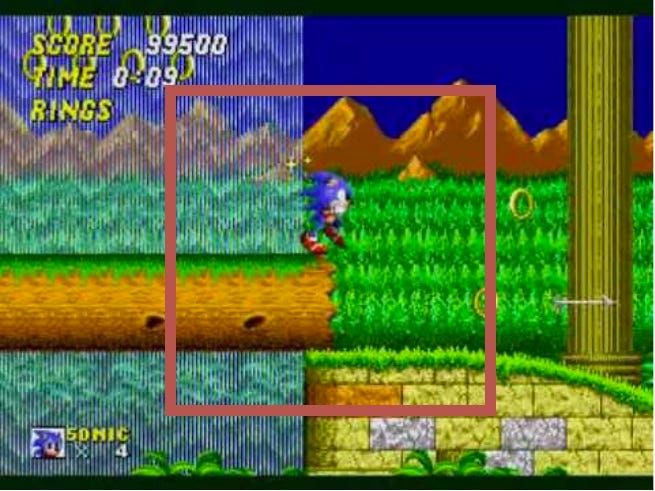
While a bit of an exaggeration as sprite reduction was made to accommodate the actual game, the red line shows the compromises made to make Sonic The Hedgehog or any made for TV game work on a Game Gear’s significantly smaller display.
Unlike his plumber rival, Sonic as a character is intended to go fast and keep going fast. This means that as a player, you must have lightning fast reflexes as you may encounter a pit, spikes, or an enemy and there are just lots of leaps of faith you must take in order to succeed. On a television with an adequate resolution, this is not a big deal as you often have enough head’s up, but being that the horizontal resolution is 40% smaller on the Game Gear, you really have no chance to predict what is coming.
The games that were intended to be on the Game Gear in the first place were playable and overall enjoyable (the Tails ones in particular), but Sonic 1 and Sonic 2 definitely do not fall into that category. They were built for the television first and were only put on the Game Gear because it was easy to port and easy to sell.
Closing remarks
I never owned a Game Gear growing up. When I was ten, my parents gave me a Game Boy for Christmas (I still have it too) and it provided me with many years of entertainment. One of my neighbourhood friends growing up did however have the console and while a few times I played it at his house, I never really felt all that invested in it.
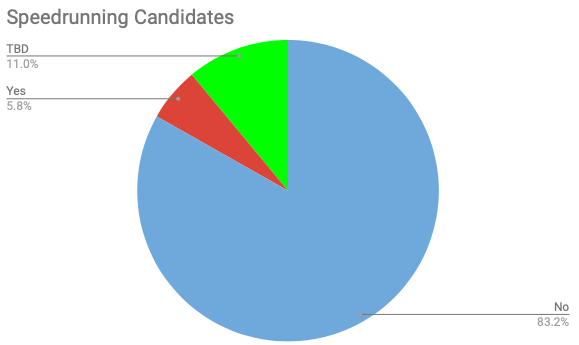
5.8% of the games in the Game Gear Library were enough for me to consider speedrunning were I to bother.
Overall, the library ranges from a few gems, some mediocre titles, and a metric tonne of software that only existed to keep the system on life support as Sega just could not compete with Nintendo.
When streaming the games on Twitch, I really tried hard to not take shots at the developers of these games as many of them went on to make excellent things later on, but there were a handful of publishers where if I saw their name appear on screen, I’d begin to anticipate the awfulness that was waiting for me.
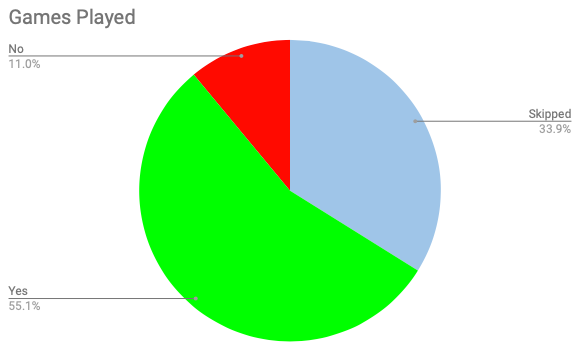
Most of the skipped games (33.9%) were sports games, entirely in Japanese, or were RPGs. 55.1% of the library as a whole was played by me and 11% I did not get around to.
About eight months into going through the catalogue almost every week, I had to give up. I was burnt out from trying to play these games even though my goal was never to finish them — just play them. I just could not do this anymore; and after chatting with a friend, I decided to end it. I’m still streaming, but the Game Gear and I are for the most part done.
-
An open-letter to my Member of Parliament with respect to the deaths of 215 children at the hands…
For context, you may read this article here. This was written to my Member of Parliament (MP), Don Davies, who represents my riding of Vancouver- Kingsway, which once was part of lands shared by the indigenous peoples of the Sḵwx̱wú7mesh (Squamish), Stó:lō (Stolo), Səl̓ílwətaʔ/Selilwitulh (Tsleil-Waututh), and xʷməθkʷəy̓əm (Musqueam).
A copy of this letter has been sent to his mailing address. I encourage you to write to your MP about this as well, as remaining silent is a privilege of which must remain unused.
Mr. Davies,
As the white daughter of settlers, I am quite disturbed and furious that indigenous persons of the lands we occupy are once again subject to sorrow and grief at the hands of racist policies of the federal government and proselytization of the Catholic church. The discovery of two hundred and fifteen (215) dead children in a mass grave is reprehensible and any suggestion that this is remnants of a “dark past” is ignorant of the fact that indigenous persons remain a systemic underclass to this very day.
While many of the individuals responsible for the deaths of these children are now deceased, many are not and furthermore, the organizations that ran these residential schools — including the aforementioned Catholic church — are still operating and often amongst the wealthiest in the world. Dismissing the deaths of children who were as young as three years old as merely succumbing to severe illness ignores that the school had seen just about five hundred (500) pupils in its operation, suggesting that two-fifths of those who entered the school’s doors never returned home to their loved ones.
These children would have grown up into adults who would have had a measurable number of them with us living today if it weren’t for the negligence of the school. Some involved with schools adjacent to this one are still alive today in particular one who was prominent with a recent major event in Vancouver.
I am a former Catholic who left the church due to its mishandling of child abuse at the hands of its priests and its continuation to suggest that those of us in the LGBTQ+ community are “of sin”. For an organization who is quick to demonize women for having ownership over their bodies and imply that I am of sin because of who I am, they’re just as quick to attempt to sweep under the rug their responsibility of the harms they’ve made against children. I often believe that the only reason why the church responded to child abuse claims and not what it did to indigenous persons in residential schools is because it was often enough that the former victims were white.
While I cannot speak on behalf of indigenous persons, I can at the very least express my anger and resentment over our government’s token gestures and inadequate actions in taking responsibility and holding persons to account for their mistreatment. The discovery of this mass grave is just the tip of the iceberg.
Do something.
Regards,
Cariad Heather Keigher
