-
My favourite tree species: arbutus

Okay. So I have a really weird thing I really love and that is arbutus trees. They’re absolutely my favourite tree in the world and I am fortunate to have quite a few within a reasonable distance from where I live.
You can find them commonly on the southern coasts of British Columbia, but they have been known to extend all the way down to northern California. You generally only find them near beaches and they prefer to be exposed and in areas with little to no water. This is why when you do encounter them you tend to be on steep hills or cliffs as opposed to flat land. They grow rather tall and can reach as high as 30 metres.
As a consequence, having one of your own in a yard is not practical. Additionally, they are terrible for making anything out of as the wood tends to grow quite crookedly due to the nature of the environments it is found in. Growing them in the city is difficult as evident by this Vancouver tree census data, there are only 9 of them on public property.
In any event, for my birthday this year, I made a point to book a place near where the trees could be found since they make me so happy. I hope that this share made you happy too!
-
Thoughts on physical Chrono Trigger releases
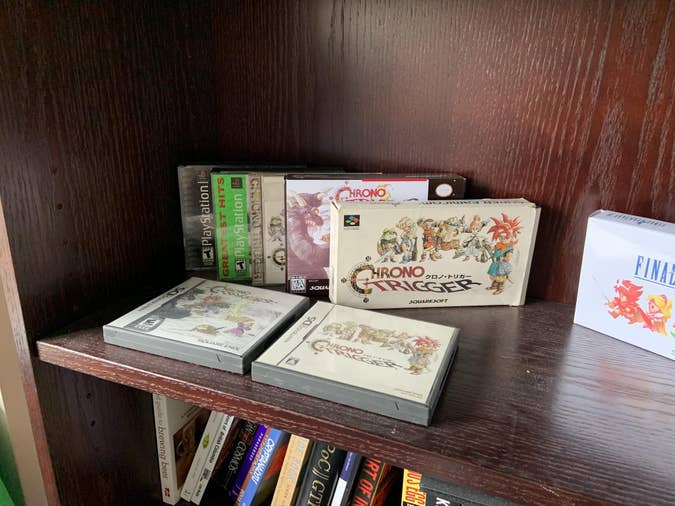
My favourite video game of all time is Chrono Trigger. I literally cannot express enough how much I love this game, its music, and its story. I have had friends get me copies of this game when travelling and it is at this point I am now just short of one final copy: the EU DS release.
I figured I’d write about my thoughts about each type of release and then tell you the version I think you should play.
PlayStation
The release of Chrono Trigger for PlayStation is weird. SquareSoft decided to use the original SNES binary of the game to provide things like graphics and text, but then added FMV and audio separate–the audio part makes sense when you think about it anyway.
However, this decision to use the SNES ROM made the game run so freaking slow. Its disc read times are abysmal and really ruins the experience if you ignore the beautiful Akira Toriyama-derived animation cuts.
The North American release happened twice on that note. Sony really loves to do “greatest hits” releases and this version is no exception. However, they really messed with the artwork in the game case as evident here.
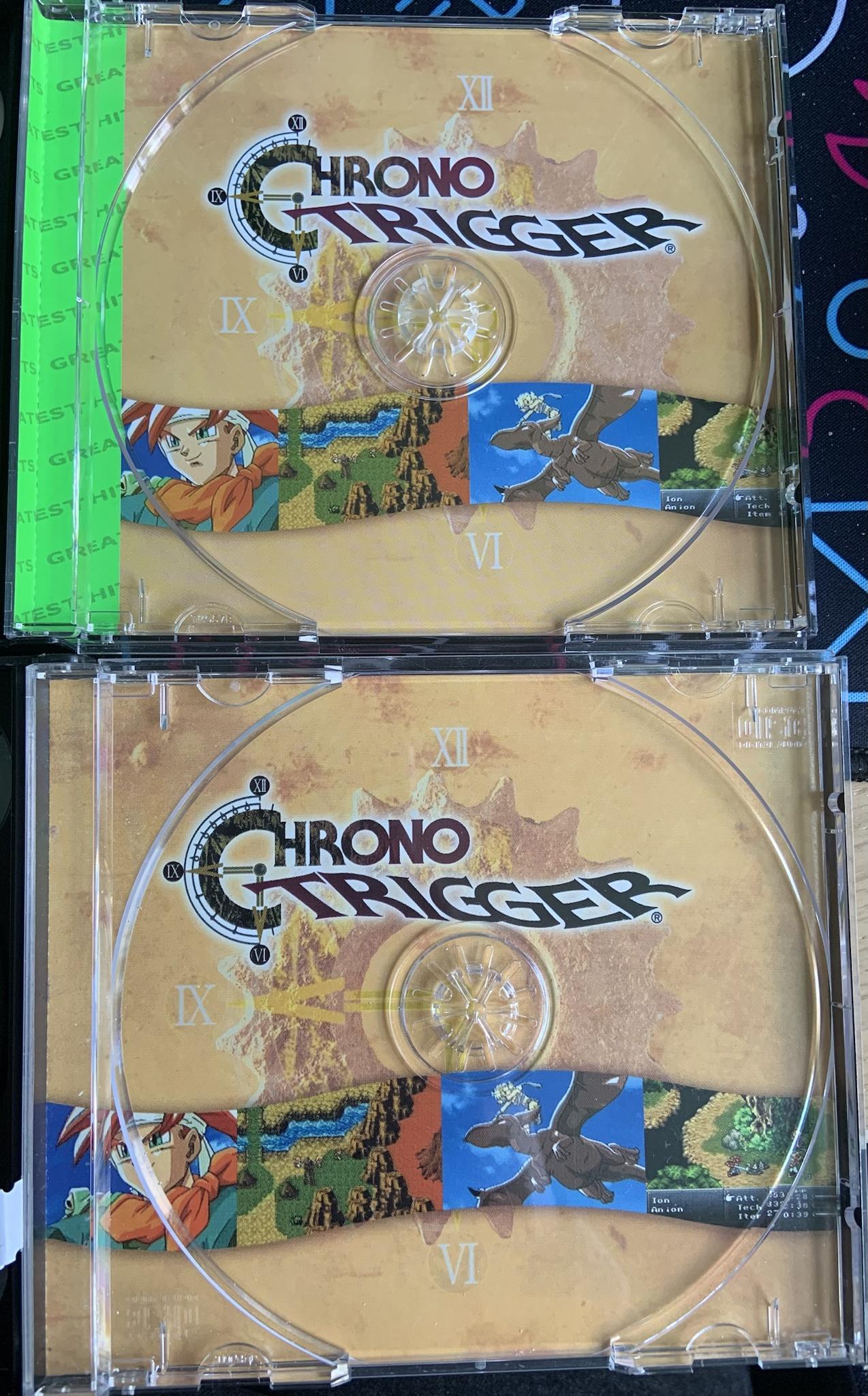
They just shifted the whole art to the right to put the hideous green label. I know that this is just a game case, but come on.
I don’t recommend making this your solo experience with this game.
Super Nintendo / Super Famicom
This is the original version and it plays as you expect it. Honestly, if this is to be your only experience with the game, it is actually great. If you decide to speedrun it, this is the only version you should bother with.
The catch with this release is the North American version is super expensive. I was lucky in that I was able to get a copy from a friend on the cheap without a game box. I ended up buying a replica box since I don’t really care about having the originals.
The Japanese version is dirt cheap however.
Nintendo DS
Okay. So hear me out: this version is probably the best to get especially if you want to buy it at an affordable price, have reasonable load times (it includes the FMV), and for the bonus extra ending that doesn’t exist in the other physical releases.
The downside of the DS release in my opinion is that it plays slightly differently due to the second screen. It doesn’t really change the gameplay, but I always felt like the experience was better on a solo display.
The bonus ending I will avoid elaborating too much on, but it does a good job intertwining the game with its sequel, Chrono Cross.
So what is the best version?
The Nintendo DS is the best version if you want a bonus ending and want a copy on the cheap.
The SNES version is the best if you want the original experience.
Choose your poison, but either way enjoy the ride!
-
When Vancouver could have been like Edmonton and Calgary
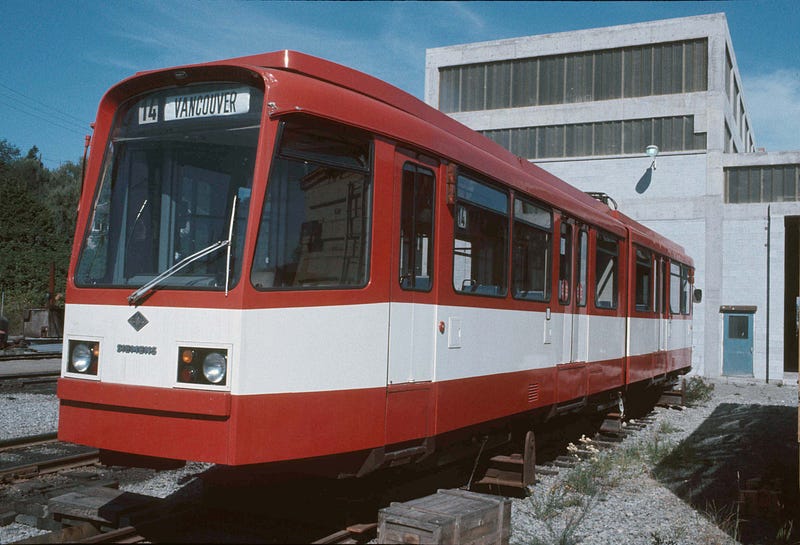
Light rail vehicle parked at a rail yard in New Westminster (City of Vancouver Archives)
When Vancouver dismantled its interurban railway network in the 1950s, it wasn’t long until local officials and the provincial government began to discuss options to recreate it in the form of a rapid transit.
In the 1970s, constant traffic problems and the oil crisis spurred the provincial government to start serious proposals for what would become the region’s rail system.
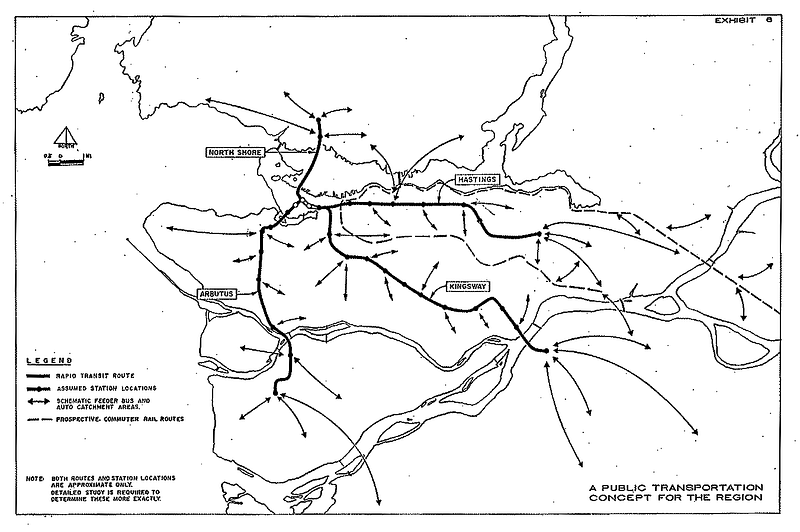
Proposed rapid transit routes from the 1970s (University of British Columbia Archives)
The above map isn’t too dissimilar to what we have today (Hastings and North Shore do not have rail as of today), but the government’s idea was to quickly revive the old BC Electric Railway by strong-arming it into existence.
And how do you force a railway to exist? By of course buying a Siemens vehicle from what was then West Germany to demonstrate the proposal along the Central Park BCER line (which is now the Expo Line).
However, in 1976, a succeeding government who didn’t like the purchase but had to receive it anyway opted to keep the train in storage. It languished in a rail yard in New Westminster until 1987 when it sold it to a group in Edmonton for a loonie. At some point in the last decade, it was returned to its native Germany where it now resides in a museum.
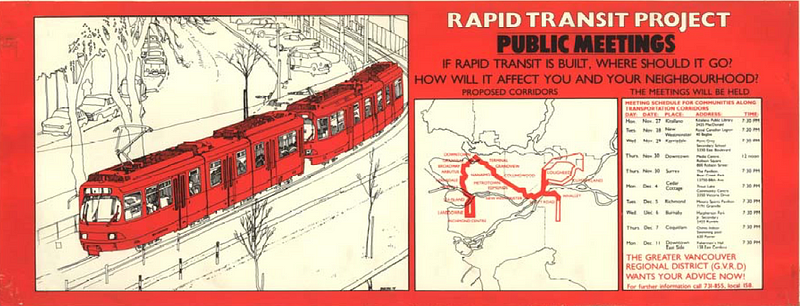
Public meeting announcement for rapid transit (City of Vancouver Archives)
Interestingly, the government also had purchased back two former-BCER interurban vehicles from owners in Washington state. These two vehicles are still in Metro Vancouver with one residing in Steveston and the other in Cloverdale.
It wasn’t the first time LRT was proposed nor the last. Almost every planned LRT implementation in Metro Vancouver has turned into some sort of light metro. There is this desire to replicate the Edmonton LRT or Calgary C-Train for some reason.
Perhaps when the City of Vancouver finally implements its street car network we’ll finally have such trains in use in the region once again?
This originally appeared on cohost.org/VancouverTransit but has been moved here due to the site’s shutdown.
-
Collingwood and Central Park
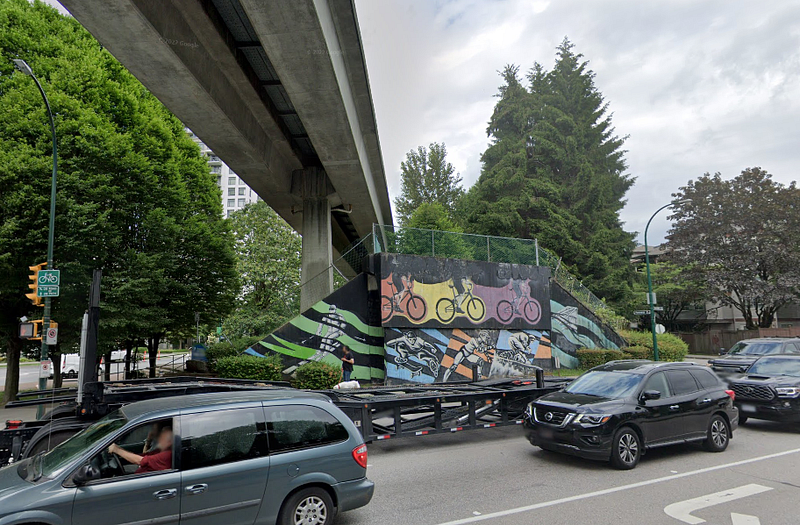
Remnants of an overpass at Boundary and Vanness
In today’s modern Vancouver, the section between Joyce-Collingwood and Patterson stations on the Expo Line is often seen as a relatively sleepy area with access to a large park, a corporate office for a major employer, and a connection to one of the Rapidbuses.
However, if you have a keen eye and opt to walk along the route, you might stumble across some interesting history that makes this stretch of the SkyTrain network rather peculiar due to it having one of the few BC Electric Railway overpasses still left standing directly underneath.
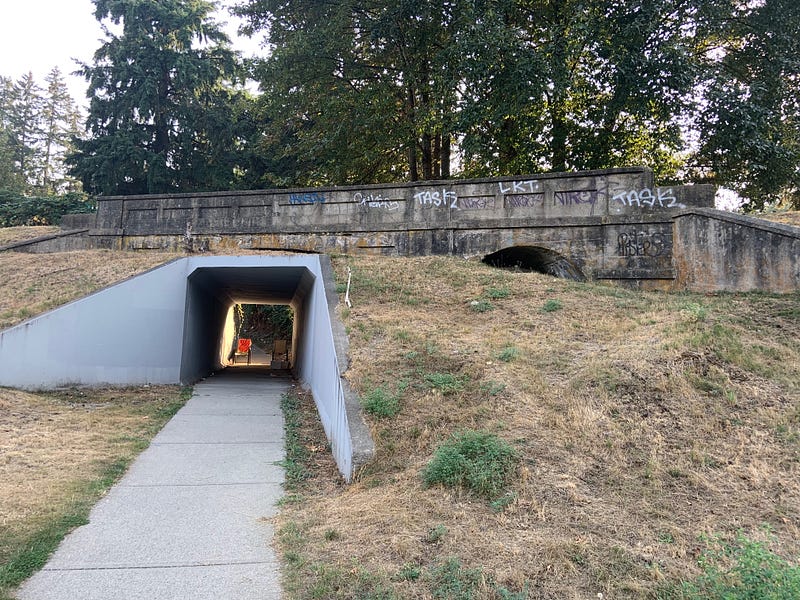
Remnants of an overpass near Kingsway and Sandell on Smith
Situated between Kingsway and Sandell on Smith, you’ll find this interesting little structure that is very much out of place and is towered over by the railway overhead. Today, it acts as an underpass for access to the office building on the other side, but beyond that it doesn’t have much of a purpose today. It likely still stands as there is a gas line which intersects underneath.
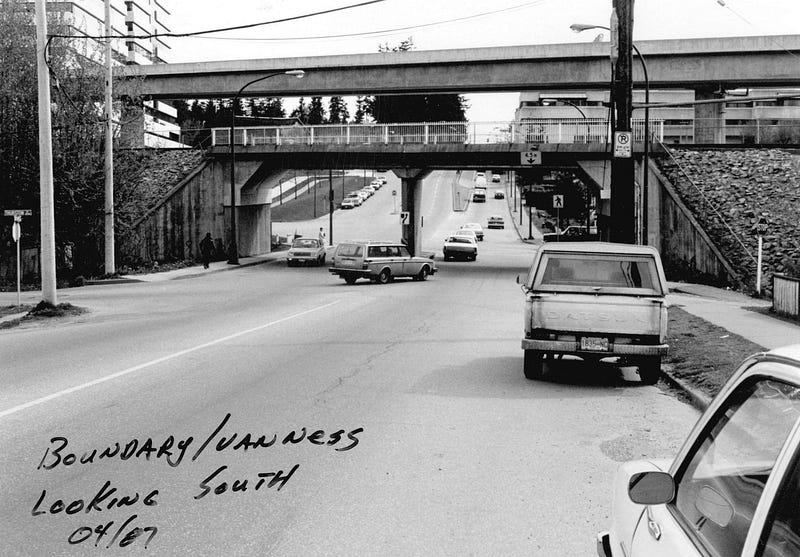
Overpass as it appeared in the 1980s at Boundary and Vanness (City of Vancouver Archives)
However, until sometime in the 1990s, there was another overpass just 100 metres to the west at the intersection of Boundary and Vanness, which remained even after the Expo Line had opened. It was to serve the industrial complex which eventually became the various apartment and condominium buildings we know Joyce-Collingwood for.
This likely resulted in a lack of need for the railway overpass to continue existing. For the most part it is now gone and now Boundary Road is now six lanes as opposed to four and it is still an uncomfortable connection for cyclists who wish to continue on the BC Parkway, which follows most of the Expo Line.
That last part is a bit of a thorn in my side as the overpass could have served a use for cyclists who wanted to avoid having to make an awkward connection to the path on the Burnaby side. Aside from that, the whole overpass itself has some interesting history and could have been a station if BC Transit had its way in the 1980s.
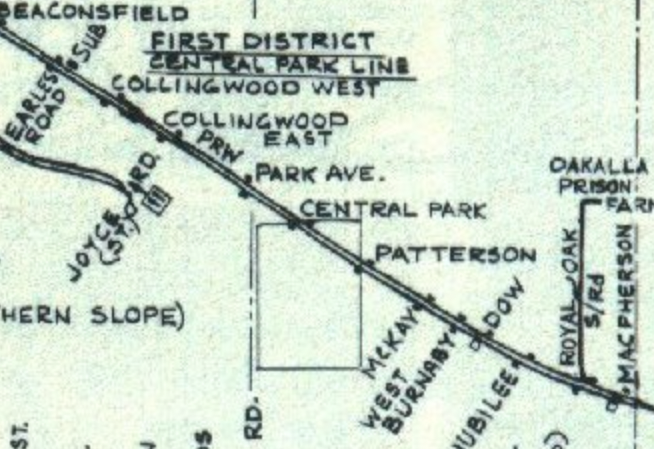
Map showing the Central Park line (City of Vancouver Archives)
Two stations on the above map do exist on the modern Expo Line: Patterson and Collingwood East, which is now Joyce-Collingwood. However, one other station on here labelled as Park Ave could have existed as it was a station under consideration when planning for the Expo Line.
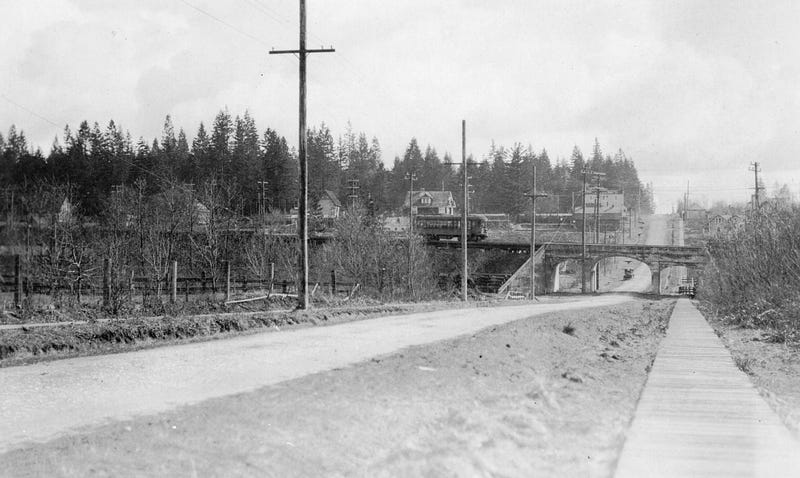
View of what is now Boundary and Vanness in the 1940s (City of Vancouver Archives)
Park Ave was really what we today call Boundary Road and its station was situated directly behind what is now one of TELUS’ corporate office. As you can see in the above photo, the overpass is very much the same design as the one I paid a visit to.
BC Transit planners were seriously considering a station called Boundary in that same spot. BCTel (who was gobbled up by TELUS in the late 1990s) was the province’s largest employer at the time and the government was keen to provide the office workers with access.
Why it never got built is unknown to me, but I imagine since the distance between Patterson and Joyce-Collingwood isn’t terribly long that they opted to not bother. As it would have straddled a zone boundary, it’s possible it could have produced a possible conflict. However, considering the existence of two consecutive stations with this fate on the Millennium Line, I think that is a moot point nowadays.
All that remains today of Boundary Station, formerly Park Ave Station is just a retaining wall for the old BCER overpass which was torn down sometime three decades ago.
This originally appeared on cohost.org/VancouverTransit but has been moved here due to the site’s shutdown.
-
Content Moderation and Why Everything and Nothing is Easy
This was written on cohost.org and thus references some matters that had happened around this time. Much of this thinking applies to other websites and is why I rarely talk about social media companies since they’re all going to be a waste of time in some way.
Rarely do I dare wade into the discourse, but I felt like it was time and I need to voice my support for the decisions made by @staff to the benefit of the site as a whole. It is hard to discuss content moderation openly and their decision to open the floor on content many who see it as objectionable as well as not was not only brave, but completely the opposite of what one would expect from much bigger social media outlets.
Like many, I find a lot of content disturbing. I am not going to hide this fact. However, regardless of the reasons for my biases, it is irrelevant to the reality that cohost faces: it is a small operation, moderation requires a lot of resources, and moderation on a service with an international audience is extremely fraught with legal jurisdictional landmines.
This point is lost on so many people in the comments made in recent posts by the cohost staff, leading to inappropriate ad hominem remarks and outright accusing them of censorship.
Let’s talk about the second point, because the first one has me quite angry.
Firstly: if you scroll down to the bottom of any page on cohost, you’ll notice that has a copyright mark belonging to anti software software club llc who describes themselves as a “not-for-profit software company”. If you have never seen the term “LLC” before, it means “limited liability company” and that should be your first clue about what grounds you stand on.
As an LLC, this makes cohost a private space. As a private space, cohost has every right within the confines of the laws they’re governed by to do whatever they want. This means and is not limited to deciding on what content they wish to permit or deny on this website. This also means they have every right to object to your participation on this website and that is regardless of what sort of financial relationship you might have engaged in.
Because of cohost belonging to an actual company, all staff have to abide by the laws of whatever jurisdictions apply to them. But because this is also the Internet, laws of which apply to users outside of the jurisdiction of what cohost itself is subject to come into play.
Many of the dissenters against cohost often look inward at their own countries’ principles and never consider the headaches others face. I am not an American and I do not live in the United States, so while I may benefit from cohost’s existence at the will of the American constitution and its federal and state laws, I am still subject to the laws of Canada and the European Union because of my nationalities.
There have been Supreme Court cases in Canada which have made certain content outright illegal to possess and there are laws in Germany against certain imagery of which I need not elaborate on. These are just a small sample of situations where if cohost wants to exist for an audience outside of the jurisdiction it is legally incorporated in.
If we flip this on its head, despite the fact that the United States is not the country I live in, the DMCA still ends up applying to me. If I download a movie through illicit means and I am caught, despite my ISP being outside of the country, they’ll still handle a DMCA claim against them because failing to do so has repercussions for them as a service if they wish to benefit from connecting to the United States. This is very simplified, but I am certain that you understand this logic.
For cohost to exist outside of an American vacuum, they have to consider what content they wish to permit. The alternative for them is to do what every small non-European website does when they don’t want to deal with GDPR: block anyone from the EU. This happens and if this small group of people were to get their way, cohost would effectively become an American-only website.
Is it censorship for them to remove content they decide is objectionable? Of course it is. Is it bad? Objectively, not really. And to further this: it’s a private space.
And that is where the first part I skipped needs to come up: this isn’t your space.
For cohost to come out and talk about this the way they did, it wasn’t an invitation for you as an individual to act as if somehow your rights were being violated because they decided as a private entity what they wish to have on their private space–irrelevant of whether or not you have paid for the service.
Also if you’re an American and you’re going to rattle off “free speech”, you should feel ashamed of the fact that a foreigner is more aware of your rights than you are.
If tomorrow it was decided by the staff that my posting about obscure video games was not going to be allowed on this website, that is their decision. Am I going to like it? No.
And that is the point: if you’re here to post content that cohost, a private company no less, objects to, you know where the door is. You can complain on some other website about cohost and let an echo chamber make you feel better, but maybe consider that there are other people here too and you have to share this space under the rules set by cohost themselves.
All of this falls on the shoulders of three people who are human beings. They are here to provide a website for us to shitpost on. They don’t have the resources to moderate content which often requires nuance to understand and examine. Speaking professionally, I do not want them to have that burden (I for certain know more about this than you do). If they don’t want the content you want to post on here, that is your problem and not theirs.
At least we don’t have to worry about people buying us custom titles.