Who is Debra Sheets and why she demonstrates the problem with short term rentals
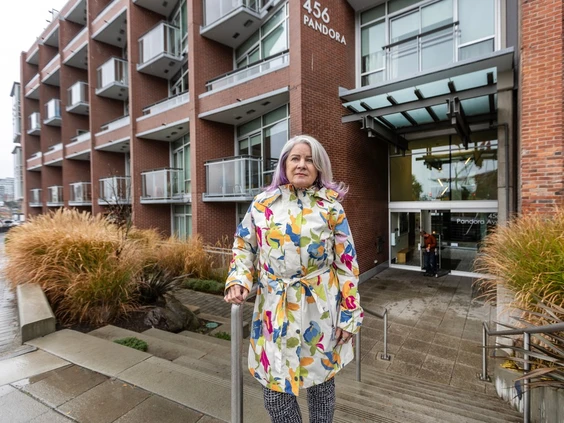
PHOTO BY DARREN STONE/TIMES COLONIST
University of Victoria professor, Alzheimer’s researcher, Airbnb operator, and resident of James Bay, an affluent neighbourhood of Victoria which includes the provincial legislature and Royal British Columbia Museum, Debra Sheets made an appearance in Tuesday’s Vancouver Sun to complain about new legislation to reduce the impact of short-term rentals.
Since I hate media pieces which make people like her appear as suffering, I feel like collecting some articles together in one spot so if anyone searches for her on Google, they’ll see her repeated lines.
Again, she is not at all new to the media as she regularly makes appearances in her fight against any legislation against her ability to protect her “investment”. I should note that since she is a public servant, we know that she made CA$156,000 in 2022.
One of the earliest appearances she has made in the press was in 2017 when she and her Greater Victoria Short Term Rental Alliance created a GoFundMe to launch legal challenges:
Debra Sheets has a business licence for her STR unit in The Janion building, which lies in a transient zone. She’s concerned about the licensing fee potentially being as high as $2,500, which is significantly higher than the $110 she paid this year.
“I feel that’s completely and ridiculously unfair,” she said, adding that she would support a legal challenge to the fee. “I’m not doing anything illegal … that’s a lot of income to lose every year, not to mention that it’s decimated the value of my unit.”
As of today, units in this building can be found going for CA$1.1 million. If this page is any indication of how much she paid for her unit when it was renovated in 2016, she would be able to sell it for double at a minimum. I am glad to see that her unit’s value was not decimated as much as she feared.
The GoFundMe raised just over a quarter of its goal. I guess they were all bleeding money collectively then.
In 2020, when vacation rentals were suffering due to the COVID-19 pandemic, she once again appeared in the news:
Debra Sheets, a member of the Greater Victoria Short Term Rental Alliance, said she doesn’t see many short-term rental owners offering their units for long-term lease.
“I will never go to a long-term rental, you face so much long-term risk,” said Sheets, who uses Airbnb to rent out her micro-loft in the Janion building overlooking the Johnson Street Bridge. “You cannot evict someone if they’re not paying rent.”
Sheets said she’s currently renting the micro-loft for $75 a night, half the typical rate.
Property owners struggling to cover a mortgage without tourist dollars are more likely to put a unit up for sale, she said.
She has seen six units in the Janion, which is zoned for short-term rentals, listed for sale.
Sheets said the lack of tourists is just one more challenge faced by short-term rental owners, who are already hit with the speculation tax, commercial taxes similar to hotels and a $1,500 City of Victoria business licence fee.
“I think short-term rentals provide crucial income to families,” she said.
She knows of one property owner with a suite who uses profits earned during the high season to offer below-market rent to students from September to April.
Sheets is also concerned that municipalities could follow the Town of Sidney’s steps to ban short-term rentals.
Debra is concerned about “long-term risk” but never took into account that legislation would be brought in down the road to limit her investment. Real estate is too sacred to have any risk I guess.
She wrote to the Town of Sidney stating the following:
What is the logic behind banning STRs? It is a protectionist move that seems to be a response to the hotel lobby which is eager to eliminate STRs. The evidence is strong that AirBnb’s offer a different service than hotels- they do not compete. Would you shut down Italian restaurants because they might compete with Mexican restaurants? If Sidney does not allow STRs then people will go to communities that do.
[…]
My time is very limited these days as the pandemic has increase my workload to support nursing students to graduate from the University of Victoria. But this issue is very important to me and I must speak out. I am not eligible for rgtiree savings accounts and my STR is my sole plan for retirement security. Your vote to support hotels over individuals who have a small business has threatened my future. I hope you will reconsider.
So of course, this struggling professor at UVic was in the media again this week and the following came up:
If passed, short-term rentals in B.C. can only be offered in the host’s principal residence, which includes one laneway house or basement suite on someone’s property. The new rules would impact municipalities with a population of 10,000 people or more and in smaller communities within 15 kilometres of a larger municipality.
[…]
Sheets, whose principal residence is in a rental home in James Bay, purchased the 250-square-foot unit in 2017 with the intent of renting it on Airbnb to fund her retirement.
The Janion building is specifically zoned for short-term rentals and so isn’t subject to a City of Victoria bylaw that, like similar laws in Vancouver and Kelowna, already restricts short-term rentals to one’s principal residence.
So she still has that unit mentioned earlier. Its value is definitely higher than what she bought it for. I guess since she now claims to be retired, she should consider selling, considering she has more than this single unit as an STR:
The retired UVic nursing instructor said she invested all her money in buying the units and now owes just over $1 million in mortgages.
She sees an uncertain future following the province’s decision to prohibit short-term rentals unless the unit is a principal residence, which is not the case for Sheets.
Hey Debra. How about instead of being a leech on housing supply you go about selling off all of your units? It’s obvious that your inaudacious investment has become a risk and thus it’s probably time to live off of your ill-gotten earnings.
You’re not the only problem causing the housing crisis, but you most certainly do not help it.