Sending Thomas the Tank Engine to space
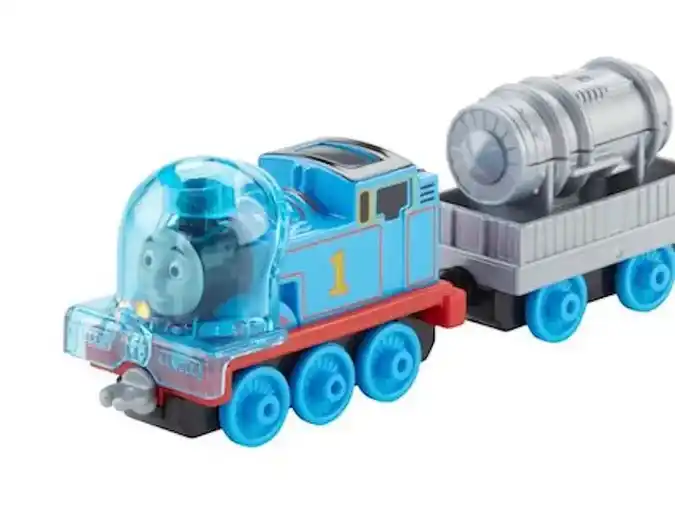
This image bugs me. It has always bugged me. So I want to know: could Sodor send Thomas to space and if so, how much would it cost? Since Sodor is modelled on the Isle of Man, I figured I can have some fun here.
The GDP of the island, the train and fuel, and then its cost will all be discussed here. I am not an economist nor a rocket scientist, so just enjoy this chost and get in the comments if you have a better answer.
Figuring out Sodor’s GDP
This is important since we want to know if the economy of the island could pull it off.
The population of Sodor is suggested to be about 60,000. The Isle of Man is estimated to be around 81,000, which makes Sodor 74% of its population size.
We don’t have any details from Sodor about its economy, but it certainly has more railways than Isle of Man, which has only one and it is just a tourist steam line. I feel comfortable with just US$5.54 billion being Sodor’s annual GDP since it’s 74% that of the Isle of Man’s.
Interestingly enough, the real world Isle has been home to a few private space ventures.
Physical details on Thomas the Tank Engine
This wasn’t too hard to figure out as it turns out to be a LB&SCR E2 class engine built in England between 1913 and 1916.
Why this is important is pretty simple: we need to know how much he would weigh and how much water is required to allow him to function.
As it stands, its dry weight is 53,600 kg. However, it also has to carry water, and its capacity there is 5,710 litres. Water is great since with the metric system we can immediately covert those litres into kilograms by switching the units, making the whole weight of the train sans coal 59,310 kg.
The coal part is tricky. Steam locomotives traditionally used anthracite coal, which weighs about 1.5 g per cm^3. This information is otherwise useless to me because I have no idea how much coal Thomas requires in order to function.
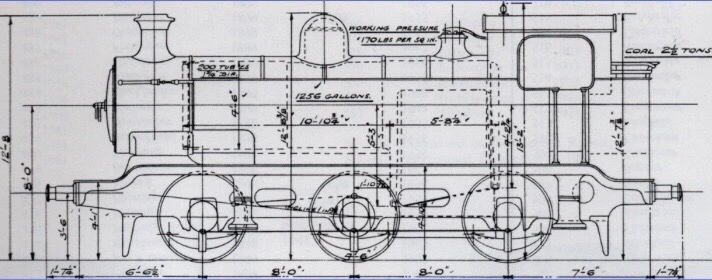
However, I lucked out and found a diagram of the train and it specifies 2.5 imperial tons of coal! That is an additional 2,540 kg, for a grand total of 61,850 kilograms for a fully-functional Thomas the Tank Engine.
Can a rocket send that much mass to space?
This is where the situation starts to get a bit dire: the best we’re going to do today is low-earth orbit.
Most modern rockets are in the range of a few thousand kilograms and as we increase the mass of the payload, the shorter the distance we’re able to travel. Getting off the ground is expensive-fuel wise as we have to fight the gravitational forces that our planet forces on us.
However, if we’re satisfied with low-earth orbit and just being a satellite or possibly docking with the International Space Station, the Falcon Heavy rocket is capable of lifting 63,900 kg to around that height, meaning we’re just about 2,000 kg under its maximum payload capacity.
So how much will this cost Sodor?
SpaceX claims that it will cost about US$1,200 per kilogram to send something to space on its Falcon Heavy–it is also the cheapest out of any competitor government or private.
At 61,850 kg, that translates to US$74.2 million to just lift Thomas up into orbit. This of course does not take into account the cost to prepare Thomas nor transporting him across the Atlantic to a launch site, but it’s a base cost. I’d pad this to US$100 million to just consider all the nonsense required to make this happen.
Going back to Sodor’s GDP, this means that 2% of the island’s economic output would be devoted to this stunt. To compare this back to Isle of Man, this would be on par with their entire tourist sector.
So it’s possible to send Thomas to space then?
It’s doable, but it would be a rather weird stunt. I have no idea how he’d get back.