Weird network shit: 100BaseVG
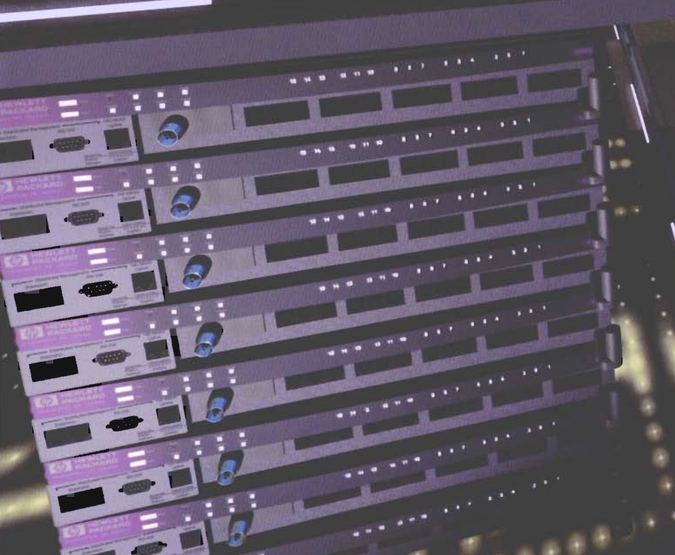
Since CRD’s post about two-port Ethernet switches came up, I was reminded about another technology: 100BaseVG.
100BaseVG is a 100 Mbit/s Ethernet standard specified to run over four pairs of category 3 cable (cable also known as voice grade, hence the “VG”). It is also called 100VG-AnyLAN because it was defined to carry both Ethernet and Token Ring frame types.
Compared to Fast Ethernet, 100BaseVG had a slight competitive edge as it was able to achieve 95% of its advertise speeds in real world tests compared to the 45% of its Ethernet counterpart. It was less susceptible to interference from outside signals and it was able to take advantage of Token Ring’s frame timing. On paper, this was pretty incredible as it was able to make use of the same cabling as 10BaseT.
So how did 100BaseVG become the Betamax equal to Ethernet? For one thing, like Betamax, only one vendor truly supported it and it was its creator Hewlett-Packard. To make matters worse, it required you to replace every single network card on any system you wanted to be part of your new fast network.
With most Fast Ethernet switches, you could have it run at 10 or 100 Mbps (and 1000 Mbps) without worrying about having to gut out the card on the other end. In 1995, this was seen as rather acceptable apparently:
Upgrading [to 100BaseVG from a 10BaseT network] is, in most cases, simply a matter of replacing existing hubs and network cards…
In the PDF I link to, it quotes AU$6,613 for a 20-port hub and AU$496 to AU$757 for a network card depending on either ISA or EISA. Adjusting for inflation and converting to US dollars, you’re looking at US$8,200 for that hub and US$640 to US$980 for the cards.
I think it’s pretty clear that you were better off keeping your 10BaseT gear and slowly upgrading to Fast Ethernet where necessary. It was pushed starting in 1995 and then died a silent death in 1998. If you have never heard of this before until now, it is no surprise.
When I was a teenager, I was given a 100BaseVG network switch from a school which used it briefly and then ditched it in favour of Fast Ethernet. I eventually realised it was absolutely junk and traded it for a Macross Plus DVD, so I think I got the better deal here.